Showing posts with label Kirkpatrick. Show all posts

Wednesday, September 9, 2015

My Cousin the Congressman

Having grown up in a politically conscious family with a deep interest in history and books, I was very excited to discover a hitherto unknown branch of my Kirkpatrick family tree several years ago. This branch has proved to be extraordinarily rich in detail about our earliest years in America (our Kirkpatricks arrived in Newcastle, Delaware, in 1736).  By the time we get to the first and second generations born on this side of the pond there are many surviving letters, journals, portraits, and even a good number of books (collected sermons, family histories, and a handful of novels!). Clearly there is a lot to blog about. But as I don't have a lot of time today to introduce the entire Kirkpatrick family, I will instead introduce you to my cousin, the Congressman.

Littleton Kirkpatrick (1797-1859) was elected to the U. S. House of Representatives from the state of New Jersey in 1843. He is my second cousin, six times removed. He was a Democrat. While he only served one term in Congress he continued to be very involved in New Jersey politics. He was Mayor of New Brunswick, New Jersey, from 1841 to 1842, and served as a trustee of Rutgers College from 1841 until his death in 1859.

Andrew Kirkpatrick (1756-1831)
Littleton was born October 19, 1797, to Andrew Kirkpatrick (1756-1831) and Jane Bayard Kirkpatrick (1772-1851). This Andrew is my first cousin, seven times removed. At the time Littleton was born, Andrew himself was a member of the New Jersey State Assembly - and three months after Littleton was born, Andrew was appointed a Justice of the New Jersey Supreme Court. Six years later Andrew became Chief Justice, a position he held for the next twenty-one years. His portrait can be seen at right.

Littleton's mother, Jane Bayard Kirkpatrick (1772-1851), had come from an important Washington, DC, family, and was a well-educated woman. She kept a journal (big chunks of which survive) for much of her life. And after her death a selection of her writings was published which included a novella, The Light of Other Days (1856).

Alas, while I have found a portrait of Littleton's father I have not found any paintings or photographs of Littleton. One would think such must exist. But I did recently acquire a letter signed by him, which I will share below.


 Dear Sir,

    We the undersigned beg leave to introduce to your notice Hanson Newton, one of the Judges of the court of common pleas, in and for the county of Middlesex and state of New Jersey, who is desirous of obtaining an appointment in the Custom House in New York. In recommending Judge Newton as a candidate for such appointment, we are performing an act of Justice to a well known, tried and consistent Democrat, who has laboured for many years in the cause of Democracy. We most cheerfully recommend him, as an upright business man, who we believe, will perform his duties faithfully, in any office you may think proper to bestow upon him.

Respectfully,
your obt. servts

Littleton Kirkpatrick [and others]

Woodbridge
20th May 1853

I've tracked down a few of the other signers: A. A. Edgar was a member of the Board of Health, and member of the New Jersey State Senate. Frank W. Brinley was the "Collector of Customs." Other unidentified names are: John M. Tufts, Thos. M. Holcombe, Jaquis H. Gordon, William Thomas, and a Mr. Haines (first name indecipherable) who boldly signed above Littleton's name.

William Paterson (1817-1898)
But the most interesting other signature belongs to William Paterson (1817-1898), who signed directly below Littleton. His grandfather, William Paterson (1745-1806), was a signer of the U. S. Constitution as well as New Jersey's first U.S. Senator, second governor of New Jersey,  and a justice on the U.S. Supreme Court (appointed by George Washington in 1793). And Paterson, New Jersey, is named after him.

The Connections between the Paterson family and Kirkpatrick family began early. Littleton's father, Andrew, had studied law in the office of the elder Paterson. The two families seem to have remained good friends.

And, in turn, the William Paterson grandson (who signed the above letter) studied law in the offices of Littleton Kirkpatrick. He was admitted to the New Jersey bar in 1838. He was elected to the state Assembly in 1842 and 1843. In 1847 he became Deputy Director of the Internal Revenue, and again in 1857. In 1882 he was appointed Judge of the Court of Errors and Appeals of New Jersey, a position he held for seven years. From 1846 to 1875 he served as Mayor of Perth Amboy.

While I have found no family connection to the Paterson family, it is this rich tapestry of historical connections that makes me so fond of this branch of the family. So much more to explore!

For my Kirkpatrick cousins who are reading this blog and are unaware of how we connect to this branch of the family, here it is in a nutshell:  Alexander Kirkpatrick (1685-1758) immigrated to America in 1736. He is my seven times great grandfather. He brought his three young sons with him: Andrew (1720-1790), David (1724-1814), and Alexander (n.d.). Son Andrew (1720-1790) leads to my branch; Son David (1724-1814) leads to Littleton's branch - indeed Littleton was David's grandson. Littleton's and my common ancestor is Alexander Kirkpatrick (1685-1758) making Littleton my second cousin, six times removed.


Wednesday, September 4, 2013

Remember, Yes, Remember Me

Poem by Josie Kirkpatrick (no date)
There are many documents preserved from the Kirkpatrick branch of my family - and one of the more unusual is a poem written by my great-great-aunt Josephine Hodge Kirkpatrick Suddarth (1848-1909). 
Josephine was the sister of my great-great-grandfather William Henry Harrison Kirkpatrick (1840-1908). The poem seems to be written as a memorial to someone. It is signed simply "Josie K." which may indicate it predates her marriage to William Wallace Suddarth (1828-1914) on June 6, 1870.
I know very little about Josephine's descendants. My grandmother and mother never really mentioned her - though it's possible my grandmother could have met her. Josie and her husband had one child that I know of, Rev. Thomas H. Suddarth (1887-1969) - though William had two children from an earlier marriage to Sarah E. Davis Suddarth (1841-1969). Josie and her husband are buried in Cedar Grove Cemetery in Lebanon, Tennessee.
I'd love to touch base with the Suddarth descendants, but so far I haven' t found any. Here is Josie's poem:
Thou who has taught me all I know
How can I bear to leave thee now.
Oh yes 'tis hard but yes 'tis so
May God protect as we go.
And all throughout the lonely days
Striving to bear any weary lot --
Perhaps tears will 'rise on the way
Enwrapped with troubles of shade.
Remembrance of those happy days
Still bathes its plumes in living light
Oh may it ever 'round me stay
Nothing to disturb I can but say.
We know this world is full of gloom
And yet 'tis but a moment's stay,
(Like that which steals across the heart
Kept off by each and every joy.)
Each year that passes by wilt thou
Remember yes remember me.

Josie K.

Friday, March 1, 2013

I Love a Piano

Edna Kirkpatrick Mott and my mom.
Today I'd like to explore the professional life of my maternal grandmother, Edna Kirkpatrick Mott (1897-1973). I often like to tell people that she was a Concert Pianist, but she had a more accurate (and funnier) description of her career: she told people she was "a Concert Pianist by profession, but a high-school music teacher by Depression," meaning, of course, that the economic crisis of the 1930s had forced her to shift gears. But I've no doubt that her classical music career was at least partially derailed by the fact that she divorced my grandfather, Robert E. Lee Mott (1890-1973), in 1928, leaving her the single parent of my mom, Mary Lee Mott Maxine (1924-2004), who was then three years old. For the record, my grandfather remained a part of both Edna's and my mom's lives after the divorce - both financially and as a father to my mom - but my grandmother had sole custody and the ultimate responsibility.

My grandmother had been born into a relatively affluent family in Bridgeport, Texas, in 1897. She was the only child of Louis Dillard Kirkpatrick (1873-1951) and Mary Campbell Kirkpatrick (1875-1966). The Kirkpatricks were firm believers in education. My grandmother graduated from Bridgeport High School in 1914 and went on to get a Bachelor of Music degree from Texas Woman's College in 1917 (now Texas Wesleyan University). She continued her study of piano after college. On October 27, 1921, she married Robert E. Lee Mott, my grandfather. The marriage lasted about seven years.

I believe for the first year after the divorce that my grandmother (and mom) may have moved back in with her parents in Bridgeport, though they also spent some time in McAllen, Texas, as well. But in the fall of 1929 my grandmother got a job teaching at the Fort Worth Conservatory of Music. It was a position where she could live at the conservatory with her four-year-old daughter, too. They moved into the Conservatory in the first days of October, 1929. The stock market crashed a few weeks later. She was busy teaching during the school year, but during the summers she took the opportunity to continue her own piano studies, taking Master Classes with famed pianist Edwin Hughes (1884-1965) in the summers of 1931 and 1932.

On March 19, 1933, at the height of the Depression she made her big debut. The Fort Worth Star-Telegraph announced the recital, even including a photo.


E. Clyde Whitlock reviewed the recital a few days later, saying among other things that the Beethoven Andante in F major was "one of the best played items on the program as to clarity of outline, melodic delineation, and rhythmic poise," and that the Chopin "was brought to an impressive climax after capable management of its technical demands, especially by the left hand. The waltz was perhaps the outstanding performance of the program in rhythmic flow and melodic charm." Oh, you might as well read the whole thing!


I'm sure my grandmother was very pleased. She sent her notices to her most important piano teacher, Edwin Hughes, and got the following letter back from him. In the letter Hughes mentions playing double piano concerts with his wife. She was also an accomplished pianist, Jewel Bethany Hughes. My grandmother cherished this letter for the rest of her life.

Letter from concert pianist Edwin Hughes

My grandmother continued to perform when she could. But she primarily taught music for the rest of her life. Around 1939 she accepted a position as music teacher at Highland Park High School in Dallas. This was at least in part because she wanted my mother to be able to go to Highland Park so my mom could meet the generally wealthy young men who attended the upscale high school. My mom had other ideas - but that's for a different blog.

My grandmother also taught privately, and I have programs for many recitals she put together over the years - such as this one from Whittle Recital Hall in Dallas in 1948. In the mid-1950s my grandmother accepted a position teaching high school music in Wichita Falls, Texas.

Music was always an important part of her life. She tried to teach me to play the piano when I was little, but alas, I just didn't have the patience. And I think it may be more difficult to take classes from one's grandmother. You certainly can't fib about practicing when you live with your piano teacher!

In the early 1940s my mom got a home-recording phonograph and she made a small number of records of the family. There are two of my grandmother singing - she had a lovely voice - but it's such a shame that there are no recordings of her playing the piano.

Edna Kirkpatrick Mott playing with two of my Caldwell cousins.

Thursday, December 13, 2012

House Hunting

Both my great-grandfather, Louis Dillard Kirkpatrick, and great-great-grandfather, William Henry Kirkpatrick, were mayors of Bridgeport, Texas - and sadly over the years we have lost track of the location of William Henry Kirkpatrick's home. I do have a fine photo of the house showing William and his wife Macarinah sitting on the front porch. Please note you may click on any of the photos to make them bigger.

Home of William Henry Kirkpatrick in Bridgeport, Texas  (taken before 1908).

William Henry Kirkpatrick died in1908 and this photo predates his death, as he is sitting on the porch with his wife, Macarinah. Mac lived in the house until her death in 1921. Here she is late in life, standing in the front yard, showing the view toward the street.

Macarinah Bridges Hunt Kirkpatrick in Bridgeport, Texas.

My memory is that my mom showed me this house a couple times when I was little and finally in 1993 on her last trip to Bridgeport. As I recall, it was on Stevens Street somewhat west of my great-grandparents' home.

A couple years ago Royce Raven, a historian in Bridgeport, sent me a photo of what he thought might be the house which stands at 1400 Stevens Street.

House at 1400 Stevens Street, Bridgeport, Texas.

Now, clearly the photos have some differences - mainly that the newer one shows a house nearly twice the size of the Kirkpatrick house in the 1908 photo. However, I was struck by how similar the right-hand side of the house was to the 1908 home - the narrow window (ignore the shutters on the newer photo) and the unusual rounded porch design. Given that the two images were taken from a very similar angle and position, I couldn't resist doing an overlay in Photoshop.

Composite image of the 1908 house and the 1400 Stevens St. house.
Below is a more transparent version that better shows how the two houses align. The pointed roof and the rounded porch seem virtually identical and the window lines up exactly, as well.

Transparent view of the two houses.

The house is approximately where I remember my mom showing it to me in 1993. And given the architectural matches, I strongly suspect this is the old Kirkpatrick home. A couple of my cousins are not convinced. I look forward to examining the house at 1400 Stevens if it is still standing when I next get to Bridgeport. I heard a couple years ago it was being eyed as a future parking lot.

ADDENDUM

One of my cousins who has not previously agreed with me about the identification of this house suggested that just possibly the original photo was printed backward and that I might try flipping it. I have now done so and (if that's the case) I am more sold than ever! Here's the same overlay, but with the pre-1908 image flipped.

Tuesday, October 30, 2012

Diane Finley Parrotta 1960-2012

Diane Finley Parrotta 1960-2012

I'm most sad to report the death of my cousin Diane Jeannette Finley Parotta. She died from cancer on October 25, 2012. She was only fifty-two.  

Diane was born in Fort Worth, Texas, July 1, 1960, to Gayle Caldwell York and Dale Finley. She graduated from Alfred M. Barbe High School in Lake Charles, Louisiana, class of 1979. Shortly after the birth of her son, she moved back to Fort Worth where she worked as Chief Financial Officer for Ross and Matthews Law Firm. Diane is survived by her parents, Gayle York and Dale Finley; her sister, Karen Finley; her son, Anthony Parrotta; and numerous aunts, uncles, and cousins.  

Diane was a lover of dogs, family, friends, and the outdoors. She was a member of the Texas Master Naturalist, the World Wildlife Organization, and the Association of Legal Administrators. Her passion for life is evident through her gardening, photography, and involvement in prairie restoration. Her extensive work and research in genealogy has brought the family closer than ever and will no doubt have a ripple effect throughout the rest of time.

Much of the above is from the fine obituary written by Diane's son, Anthony. It was Diane's work and research in genealogy, which Anthony mentions above, that brought Diane and me together. While this post shares the basic details of Diane's life I want to share how Diane's genealogy work brought us together - reconnecting two once very close branches of the family.

After the death of my mother, Mary Lee Mott Maxine (1924-2004), I felt very alone and isolated. My mom had been an only child and her mother had been an only child. The once huge extended Campbell family had been scattered and spread thin by time, geography, and marriage. I felt I had lost so much when my mom died; I desperately wanted to preserve her family stories, our family history - even if I had no one to share it with. I went out and bought Family Tree Maker. I began entering all the basic family data, and every couple days I'd upload it to the "World Family Tree" part of their website. Almost immediately I got an alert that an "exact match" had been found on another tree uploaded by a certain Diane Finley Parrotta. I had no idea who she was - neither Finley nor Parrotta were family names as far as I knew. I sent Diane an e-mail. She immediately wrote back, and over the next couple days we talked on the phone several times. Diane shared my e-mail with her mom, aunt, and sister. It became clear that two once closely intertwined branches of the family had been reunited. Here's our family connection in a nutshell:

Andrew Campbell and Mary Gemell
Diane and I share the same great-great-grandparents, Andrew Campbell and Mary Gemell (seen at left). She is descended from their daughter Jeannette (Diane's middle name) and I am descended from their daughter Mary.

Jeannette Campbell married Charles Cary Caldwell and they had one child, a son Charles. Sadly both parents died in 1924, leaving eleven-year-old Charles an orphan. He went to live with his aunt and uncle,  Mary Campbell and Louis Dillard Kirkpatrick (my great-grandparents), in Bridgeport, Texas..

Charles became, in effect, my grandmother's little brother and my mother's big brother. Charles was sixteen years younger than my grandmother and eleven years older than my mom. After my own grandparents divorced in 1928 my grandmother and mom spent much time living with Mary and Louis Kirkpatrick and their adopted son Charles. My grandmother was a Dallas/Fort Worth area music teacher, so essentially all holidays and all summer she and Mom lived in Bridgeport.

In the early 1940s Charles married Lois Parish. Sadly, Charles inherited his father's weak heart and he died in 1945 at the age of thirty-two, leaving behind his two young children, Gayle and Carol. Gayle is Diane's mom. The families stayed fairly close for the next decade or so.

Louis & Mary Kirkpatrick with young Gayle Caldwell and her infant sister Carol.
Below is a photo of Diane's mom Gayle playing the violin (center top) and Diane's Aunt Carol (bottom left) sitting beside my grandmother Edna Claire Kirkpatrick Mott (center) at the piano.

Edna Kirkpatrick Mott with Gayle and Carol Caldwell circa mid-1950s.

Diane's mom Gayle even participated in my parents' wedding party in 1958. But then our two families began to drift apart. People got married, they moved, relocated for graduate school, had kids, divorced, married again - names changed, addresses got lost.

That is, until 2004 when Diane and I found each other. We continued to share e-mails and phone calls. My reconnection spread to Dianes's sister, Karen, and especially to Diane's mom, Gayle. In 2009 we all finally met face-to-face. Around Christmas my partner and I spent several days in Fort Worth. We stayed with Gayle and had several good visits with Diane and Karen and their aunt Carol. The years melted away and the sadness and loneliness after my mom's death melted as well. The past didn't feel so lost anymore.

There was a future, too, as we all got to know each other through e-mails and especially Facebook. I deeply regret that the families lost touch for so long. Reconnecting would not have been possible without Diane's interest in the family, in genealogy, and in reaching out to connect with others.

I am so grateful to her for giving me my family back. Luckily she was surrounded by her large loving family at the end. I wish we had had more time to know each other. But she touched many people and many things, and the ripples of her life will radiate outward for a very long time.

Good-bye, Diane. Thank you.

A celebration of life will be held at 3 p.m. Tuesday, October 30, at The Unity Church located at 5051 Trail Lake Drive, Fort Worth, Texas 76133. In lieu of flowers, contributions can be made in Diane's memory to the Humane Society of North Texas at 1840 East Lancaster, Fort Worth, Texas 76103. Arrangements have been made by the Major Funeral Home & Chapel, Fort Worth, Texas, telephone 817-568-0440.

Wednesday, October 10, 2012

Mamie and the Chicken

Mary E. Campbell Kirkpatrick circa late 1950s
I have some memories of my great-grandmother Mary Elizabeth Campbell Kirkpatrick (1875-1966). She died when I was three, shortly before my family moved to Albuquerque. 

The photo at left was taken before I was born, but it is much the way I remember her. Everyone in the immediate family called her Mamie. She conducted the church choir most of her adult life, and my mom said that Mamie had a voice that could have made her an opera star. 

You will certainly learn more about her in future blogs, but today I will share one of the funnier Mamie stories.

Mary E. Campbell Kirkpatrick - early 1910s

Back in the earliest days of the 20th century, when my grandmother, Edna Claire Kirkpatrick (1897-1973), was a little girl, she witnessed the events that led to this blog post, the events that led to this favorite family story of the infamous day when my great-grandmother tried to choke her chicken.

I had best explain. Mamie and her husband, Louis Dillard Kirkpatrick (1873-1951), lived with their daughter in Bridgeport, Texas. They owned a large house on fourteen acres of land. They had pecans, various fruit trees, and they kept chickens. If the dinner-time meal was to be chicken, Mamie would ask Louis to please go get her a chicken, and he'd go out to the yard and select a tasty looking bird. He would hold it by the head and, with a quick spin of his wrist, the chicken's head would come off, and he'd take the chicken to my great grandmother for cleaning and cooking.


Louis Dillard Kirkpatrick and the chickens in Bridgeport, Texas.

But one day she forgot to ask Louis to get her a chicken. She had witnessed the deed on many, many occasions. And she thus thought, "Oh foot! I can kill a chicken! I've seen Louis do it a hundred times!" So she went out into the yard, snuck up on the feathered dinner-on-legs, and grabbed it by the head. It squawked and flapped its wings, and she took a deep breath and started to spin the chicken around. And she continued to spin the chicken.

The chicken was not amused. It still squawked and flapped its wings. But Mamie kept on spinning the chicken. Whoop, whoop, whoop, whoop, around the chicken went! All the other chickens looked on in wonder! Whoop, whoop, whoop, whoop, around the chicken went!

Eventually, my great-grandmother let the chicken go. With a sigh, she went into the house to find something else to make for dinner.

According to family legend, that chicken eventually died of old age - with its head permanently wrenched, turned backwards looking over its shoulder. When my great-grandmother would see the chicken out in the yard she would look at it with remorse and sigh . . . "Oh, Louis, oh . . . oh . . ."

Sunday, October 7, 2012

Cousins in Common, featuring Nathaniel Bartlett

One of the reasons I became interested in tracing my family tree was to see if David and I were somehow related by blood. I mean, the chance that sometime, somewhere, our lines intersected isn’t all that remote, is it?

Well, after a couple years of wide-ranging research on both our parts, I haven’t come up with a clear common ancestor for both of us.

I found connections between David’s line and mine by marriage, usually several marriages. For instance, we are each connected by chains of marriage both to Yankee General (and later US president) Ulysses S. Grant and to Confederate General Robert E. Lee.

Although I have not yet come across a common ancestor for both David and me, I did find a branch of relatives common to us both. A member of each of our families married each other and had a child who had descendants. David’s cousin Ebenezer Bartlett, Jr. (1694-1781), and my cousin Mary Rider Bartlett (1694-after 1723) married in 1718 in Duxbury, Plymouth, Massachusetts, where their son, Nathaniel Bartlett (1722-1802), was born. David and I are both related to Nathaniel Bartlett and all of his descendants.

Nathaniel Bartlett's mother was my cousin Mary Rider Bartlett. Mary's paternal grandparents were Samuel Rider (about 1601-1679) and Anne Gamlett Rider (abt 1605-1695). Samuel and Anne Rider immigrated to North America from Northampton, England, between 1636 and 1638. They settled in Yarmouth in the Massachusetts colony. They are my great-great-great-great-great-great-great-great-great-grandparents. That’s nine greats.

Gravestone of "Deacon" Benjamin Rider (1761-1854), my great-great-great-great-great-grandfather, in the line between Nathaniel Bartlett and me. Rider Cemetery, Chardon, Geauga County, Ohio.
And that makes Nathaniel Bartlett my second cousin, eight times removed.

Nathaniel Bartlett’s father was David's cousin Ebenezer Bartlett, Jr. (1694-1781).  Ebenezer’s twenty-two times great-grandfather was Waltheof, Earl of Northumbria (1050-1076). Waltheof is David Maxine’s twenty-five times great-grandfather.

On the left: Anderson Kirkpatrick (1808-1887), David's great-great-great-grandfather, in the line between Nathaniel Bartlett and him.
Twenty-five greats is an estimate—there could be a few more greats in there. David’s Kirkpatrick line of ancestry, which connects him to Waltheof, has a blank period, so the exact number of generations between Alexander Kirkpatrick (1685-1758) and his purported ancestor Roger Kirkpatrick (abt 1410-?), husband of Margaret Somerville, is currently unknown.

Despite the Kirkpatrick lacuna, that makes Nathaniel Bartlett David’s estimated twenty-third cousin, three times removed.

David has at least two other potential blood connections to Nathaniel Bartlett.

His second potential common ancestor with Nathaniel Bartlett is Geoffrey Plantagenet, Count of Anjou and father of King Henry II of England. Geoffrey is possibly David’s twenty-six times great-grandfather and Nathaniel’s nineteen times great-grandfather. But the line of ascent from David to Geoffrey Plantagenet has at least one doubtful connection, the parentage of Mary Grisselle Gibbone. I don’t necessarily dismiss this connection, but I find it questionable.

Geoffrey Plantagenet has been claimed as David’s twenty-six times great-grandfather through another line, too. This claim relies on the parents of Mary Stanley being George de Stanley and Joan le Strange. That parentage seems to have been fabricated by John S. Wurts, a twentieth century genealogist whose work is not up to current genealogical standards. So I’m afraid I don’t accept this family connection between David and Nathaniel Bartlett.

Waltheof, Earl of Northumbria, or rather, a fifteenth century statue identified as Waltheof, from the west front of Croyland Abbey in Crowland, Lincolnshire, UK.
But David’s descent from Waltheof, Earl of Northumbria, seems solid. Many of Waltheof’s descendants in both David’s and Nathaniel Bartlett’s lines have connections with the royal families of England and Scotland. And many are also connected with Northampton, England, the place, as I noted above, where my common ancestors with Nathaniel Bartlett, Samuel and Anne Rider, lived before emigrating.

How about some more connections among Nathaniel, David, and me?

Nathaniel Bartlett’s great-great-great-grandfather was Richard Warren (abt 1580-1628), who arrived at Plymouth Rock in 1620 aboard the Mayflower with the Pilgrims. He was one of the ten people in the landing party with Myles Standish. Richard Warren wasn’t himself a Pilgrim, but a merchant from London. His wife Elizabeth Walker Warren (abt 1583-1673) and their daughters followed Richard from England to the Massachusetts colony later on the ship Anne. Richard Warren’s previous ancestry is unknown, but that hasn’t stopped a lot of people from fabricating pedigrees for him, some back to the English royal family and beyond. If there’s a grain of truth to Richard Warren being related to English royalty, then that’s another family connection to David’s line.

I have two other family connections to Richard Warren myself, not by blood but by marriage. First, Richard Warren’s granddaughter Sarah Bartlett (abt 1636-before 1680) married Samuel Rider (abt 1632-1715), a son of Samuel and Anne Rider, my common ancestors with Nathaniel Bartlett. And second, Richard Warren’s nine times great-granddaughter, Helene Thelma Stafford Grant Waste (1902-1985) married Charles Elwood Grant (1900-1945), her first husband, who was my second cousin, twice removed.

This is, I suspect, Charles Elwood Grant, four years old in this detail from a 1904 Grant family photograph. The identifications of children in the larger photo are confused.
Nathaniel Bartlett’s direct descendants have been traced down to today. I’d like to show you a couple of them. Nathaniel’s great-great-granddaughter was Elizabeth Ricker Robinson (1859-1942), whose photograph you can see here.

Elizabeth Ricker Robinson (1859-1942), great-great-granddaughter of Nathaniel Bartlett. Used with permission of John Hurlin Robinson.
Elizabeth and her husband, Walter Franklin Robinson (1855-1940), had a daughter named Helen Franklin Robinson (1885-1967), whose wedding photograph is posted below. Helen and her husband Don Hurlin Robinson (1889-1950) had one son who is still alive and who is the father of several children, including John Hurlin Robinson (b. 1951), and grandfather to several grandchildren.

Wedding picture of Helen Franklin Robinson (1885-1967), great-great-great-granddaughter of Nathaniel Bartlett. Used with permission of John Hurlin Robinson.
John Hurlin Robinson is my ninth cousin, once removed. He's David's estimated twenty-sixth cousin, four times removed. John has his own genealogical website, which you can see by clicking here. I thank John for allowing me to post photographs of his grandmother and great-grandmother. If you want to see photos of some of David’s and my living Robinson relatives, visit John’s site. Their ancestral line joins both David’s and mine at Nathaniel Bartlett, making all of us relatives.

Wednesday, October 3, 2012

Blow, Winds, Blow

One of my cousins is writing a history of the Civil War career of one of my ancestors: Captain John Dillard Kirkpatrick (1838-1895). John was the brother of my great-great-grandfather William Henry Kirkpatrick. This cousin and I have been exchanging genealogical information for a number of years now, including the various Civil War letters each of our families inherited. There is one thing I have not been able to share, as it can't be photocopied, scanned, and e-mailed.

It is a large pink conch shell that has probably been in the family for a good two hundred years. When I was little I remember the shell being in my grandmother's room. I would come in and look at it, and she would tell me the story. The shell had belonged to Grampa Kirkpatrick and it had hung near the front door of their big house. When the day's work was over, Grampa Kirkpatrick would go out on the porch, take the shell from its hook, and he'd blow into the shell - which was sort of like a horn - and he'd call the slaves in from the field.

This was all very abstract to me when I was a child. There seemed a distinct separation between the past, slavery, the Civil War, etc., and the very liberal and progressive family I grew up in. My mom had been deeply involved in the civil rights movement from the mid-1940s.

But as I got deeper into genealogy, the issue of slavery became much more problematic. If one starts looking at U.S. Slave Schedules and going through Trust/Deed books and seeing one's relatives buying and selling human beings, reading Last Will and Testaments where relatives are leaving certain human beings to others, well, it becomes very real. I'll be talking a good deal more about slavery issues in future posts.

But in my research one thing puzzled me. I could find no clear evidence for which particular "Grampa Kirkpatrick" the shell belonged to. The family stories clearly implied it was Anderson Kirkpatrick (1808-1887), my great-great-great-grandfather. But I can find no evidence that Anderson owned slaves. Perhaps his father John Kirkpatrick (1770-1808) owned slaves - indeed, I think it likely. Surviving property records and the Slave Schedules show many of Anderson's ancestors owning slaves, and three of his brothers did as well. But the solid documentation of the Kirkpatrick brothers' slave holdings only made the absence of such records for Anderson more puzzling.

Anderson and his sons were well-off, well-educated, and very religious. It would not be out of the question that Anderson had not held slaves. I just wish I had positive proof one way or the other, as either scenario creates a better picture of the man and his children.

But there is the story of the conch shell. Either Anderson owned slaves or the shell was his father's or possibly the story got slightly off and the shell belonged to my other great-great-great-grandfather, James Madison Hunt (1810-1860). JMH was the father of Macarina Bridges Hunt who married Anderson's son, William Henry Kirkpatrick. My grandmother, who first told me the story of the shell, knew both of these people, William Henry and Macarina Bridges (her paternal grandparents), quite well. Macarina died when my grandmother was twenty-four. So my grandmother heard the story from two people who had reached adulthood before the Civil War. Macarina grew up in a slave-owning household. In the 1860 U. S. Slave Schedule her father, James Madison Hunt, is listed as owning seven slaves.

James Madison Hunt - Slave Schedule 1860.

He owned two men aged 26 and 21, three women aged 40, 16, and 14, a boy aged 10 who was dumb, and a little girl of 4. As I mentioned above, this gets very real very fast.

Macarina Bridges Hunt (Kirkpatrick)
So I don't think it unlikely that Macarina Bridges Hunt Kirkpatrick might have told the tale to my grandmother by simply saying this shell belonged to Grampa - meaning Macarina'a father and not Grampa Kirkpatrick. There's probably no way to know and in either case at least one of my great-great-great-grandfathers owned slaves. And I now possess the shell one of them used to announce the end of the work day.

Well, the original purpose of this blog post was to be able to share information about the conch shell - but I felt very wary of romanticizing the past and wanted to balance family nostalgia with a little cold history.

The conch shell is very old and worn. As you can see in the photo below, many layers of shell have been chipped off in the last two hundred years and the grip area has been rubbed smooth. You may also notice a small hole drilled in the upper lip. This is where the ring or wire went through, enabling the shell to be hung at the front of the house on its hook.


When I was little I would pick up the shell and blow into it and nothing happened. My grandmother would tell me it was very difficult to blow and get the right sound. But when I was in fifth grade I took French horn for a year and I quickly realized the same technique of basically blowing a "raspberry" into the French horn would work on the Kirkpatrick Family conch shell. It worked. My mom suggested I should learn to play bagpipes. I declined.

Below you will find a link to play a short MP3 sound file of me blowing the conch shell.
Depending on your audio player you may need to click the little PLAY arrow.

Monday, October 1, 2012

The Kirkpatrick Family

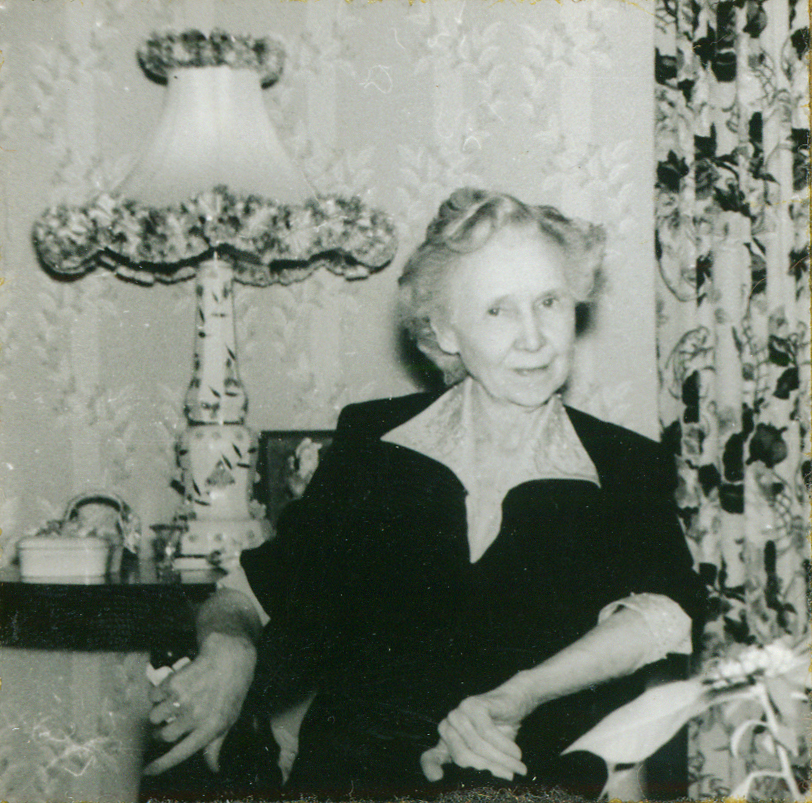
Edna Claire Kirkpatrick Mott.
My mother's family was always into family history and no branch was more talked about than that of the Kirkpatricks.

My grandmother was Edna Claire Kirkpatrick, and her father was Louis Dillard Kirkpatrick (1873-1951). I knew my grandmother well - indeed, when I was a child she lived with us until her death in 1973. I did not know my great-grandfather Kirkpatrick except through family stories - which in many ways made him more real than many of my living relatives.

The Kirkpatrick line (of Sumner County and Wilson County in Tennessee) was far and away the best documented part of my family. I own the family bible of my great-great-great-grandfather, Anderson Kirkpatrick (1805-1887). It includes information back to his father, John Kirkpatrick (1770-1808). From that point on the family is well documented with various letters, slips of paper, and many photographs from the late 1800s on. One of the most interesting things is the small stash of Civil War letters. The family had been in Tennessee for several generations - thus the Kirkpatricks were with the Confederacy.

I'd had a mild interest in genealogy since I was a kid and had become the self-appointed family historian, but a much deeper interest in genealogy kicked in after my mom died in 2004. I think I was looking for a way to strengthen my connections to the past, as the present felt so fragile.

Anderson Kirkpatrick and Emmaliza Moss Kirkpatrick.
I quickly found several long-lost Kirkpatrick cousins, and with the internet I was able to push the Kirkpatrick family line back several generations beyond my great-great-great-grandparents, Anderson Kirkpatrick (1808-1887) and Emmaliza Moss Kirkpatrick (1812-1874), seen in the photo at right.

My oldest verifiable Kirkpatrick ancestor at this point is Alexander Kirkpatrick, born 1650 in Watties Neach, Dumfriesshire, Scotland. His son, also an Alexander Kirkpatrick (1685-1758), moved from Scotland to Belfast, Ireland, around 1725 and in 1736 he immigrated to America. He arrived in New Castle, Delaware, but he and his family settled in Mine Brook, New Jersey. This Alexander Kirkpatrick, the immigrant, is my seventh great-grandfather.

I will be sharing much more information on the Kirkpatrick family in future posts: the American Revolution, slavery, the American Civil War, how the family got land in Tennessee, and how my great-great-grandparents moved to Texas shortly after the Civil War. And how, via our Kirkpatrick ancestors in Scotland, the family connects to Robert the Bruce and the royal families of Scotland and England.

I wish my great-grandfather Louis Dillard Kirkpatrick could have lived to know so much about the family. He loved history with a passion!

My great-grandfather Louis Dillard Kirkpatrick, circa 1949.