Showing posts with label Hietanen. Show all posts

Tuesday, November 17, 2015

Finn Findings

It’s difficult to find Finnish relatives with the results of the Ancestry.com autosomal DNA test—at least, that’s what I claimed in an earlier post here. A cousin of mine read that post about my frustration with the roadblocks and arduous searches required. I don’t think cousin Bob—who’s done amazing work to extend our Hietanen family tree back several centuries—thought it could be quite as grim a situation as I made it out to be.

He e-mailed me to suggest a few strategies. I e-mailed him back with information from my Ancestry.com DNA match list. Bob worked on a couple names. He found the DNA match list cumbersome enough that he looked for online search tools to make it easier to find connections. He even began to develop some search tools of his own. Bob does computer programming, so that’s the sort of thing he can do.

Yet it wasn’t long before he came to a screeching halt. The Ancestry.com model of trying to find connections among DNA matches is so unwieldy as to be discouraging.

But by that time Bob and I both had our blood up to do some serious research.

Previously Bob had sent me links to online Finnish Church Records. These are the official records of births, marriages, deaths, and so on of the Finnish populace for several centuries. Because Finland had no civic entity assigned to gather the information for these records, the church recorded these life landmarks for the Finnish people.

I’d long been intimidated by the idea of Finnish Church Records. I can’t read Finnish. I know about half a dozen Finnish words—things such as sauna (and, yes, I pronounce it correctly—so that it sounds more like sow-na than saw-na). But throw kuulutettujen and muuttaneiden at me and I’m lost. Other family researchers have dug into the depths of the Finnish Church records. I’ve been content to leave the heavy lifting to them and grateful for what they share.

But Bob’s shared a lot of his research with me over the years. I didn’t want him to think I was just slacking off to let others take care of all the hard stuff.

So I looked at one of my DNA matches that had caught Bob’s attention. I’ll call that DNA match “Mitch.” “Mitch’s” family tree was clearly of Finnish descent on his mother’s side. Months ago I’d found the name Luoma on “Mitch’s” tree. I have Luomas on my tree. I’d made a note that Luoma might be the connection between me and “Mitch.” Now I started with the Luoma on “Mitch’s” tree and worked backward. I quickly came across the surname Stoor. Mitch’s Stoor ancestors lived in Kortesjärvi, Finland.

I knew I had one Stor ancestor from Kortesjärvi, Finland—Antti Stor, my great-great-great-grandfather.

I didn’t think the difference in the spelling of the last name—Stoor versus Stor—probably made any difference. In the end, it didn't; they're cognate spellings, along with Storr, and are interchangeable. There’s a lot of variation in the spelling of Finnish names from the seventeenth, eighteenth, and nineteenth centuries. I felt pretty confident that Stoor/Stor from Kortesjärvi was the key to my connection with “Mitch.”

I mentioned this to Bob, then dove headfirst into the Finnish Church Records online at the Finnish Family History Association (FFHA).

Navigating the records wasn’t as hard as I thought it was going to be. On the FFHA site, they’re divided geographically. So I looked up Kortesjärvi and was confronted with a list of Finnish words I couldn’t even pronounce, much less understand.

But Google translate exists for a reason.

I started blindly with the Church Communion records, simply because there were more of them than anything else. This turned out to be a fortuitous accident. The communion records list whole families—the first name and patronymic of father, mother, and children—along with the birth date of each family member. The families are grouped by surname/farm name. Until the twentieth century a Finnish farm name generally equaled a surname, especially in rural communities. So the communion records provided the exact type of information I needed in order to work my way back a generation at a time.

I began with the surname/farm name of Stoor/Stor in Kortesjärvi and soon found my great-great-great-grandfather Antti Stor, born December 10, 1835.

Of course, Antti’s name wasn’t recorded with that spelling. Sweden ruled Finland for a long time. Swedish became the official language of Finnish records. Finnish first names have Swedish versions. Finnish patronymics, based on first names, also have Swedish versions. Instead of Antti Matinpoika Stor, I found Anders Mattsson Stoor. His parents and siblings were listed with him.

One of the several Finnish communion records showing Anders (Antti) Stoor (fifth name, preceded by the word "Son"), born December 10, 1835. His father Matthias Gustafsson Stoor (first name) was born July 10, 1802, in—as noted in the third column—Palojärvi.

From there it wasn’t too difficult to go back another generation. But what was this? In an earlier communion record, Antti’s father, Matthias Gustafsson, born 1802, had the word Palojärvi following his birth date. He’d been born on the Palojärvi farm, not the Stor farm. I pushed back another generation, but the name Stor had completely disappeared from this line of descent.  Dead end.


Communion record for Gustav Johanisson Palojärvi (bottom name), born October 12, 1760, father of Matthias Gustafsson, with his parents, Johan Johanisson Winikainen Palojärvi (first name), born December 26, 1730, and Maria Matthiasdotter (second name), born May 12, 1729, and other family members. No sign of Stoor/Stor here.

So I went back to Matthias Gustafsson, born 1802. I figured that his wife, Maria Andersdotter, born 1801, must have been the Stor.

At the same time I was combing the communion records on the FFHA site, cousin Bob had been delving into the Finnish Church Records at the online HisKi project of the Genealogical Society of Finland. Bob was also trying to find the connection between me and “Mitch.” The HisKi project has fewer online Finnish Church Records than FFHA. But HisKi has some different records and best of all, the HisKi project has a search function in English.

Bob found that Matthias Gustafsson’s wife Maria Andersdotter, who hadn’t been a Stoor/Stor before marriage, had been a Försti. I dug around and pushed back a couple generations up the Försti tree. No Stoor/Stor appeared there. Another dead end.

I subsequently hit a few more dead ends looking for a Stoor/Stor connection between “Mitch’s” family tree and mine. Despite the Stoor/Stor dead ends, all this research Bob and I were doing was nevertheless productive. It filled in previously unknown branches of my family tree. All these people were my relatives, even though most of them weren't Stoor/Stors. And I was successfully navigating the Finnish Church Records.

I went back down the line to my great-great-grandfather, Matti Nikolai Stuuri (1861-1922), son of Antti Stor, who had immigrated to the USA from Finland in 1889. He’s the one who changed his surname Stor to Stuuri in his new country. The reason for the change is not apparent. The story I’ve received is that Stor was an unfamiliar last name and Stuuri was more comprehensible to the inhabitants of Fairport Harbor, Lake County, Ohio, because there was another Finnish immigrant family there named Tuuri. That seems like nonsense to me—Stor seems much simpler than Stuuri—but I wasn’t around at the time. Maybe it made sense then.

Anyway, Matti Nikolai Stuuri’s wife was Wilhelmina “Walpori” Erkkilä (1860-1925). Could she have brought the Stor name into the family? I pushed back through the Finnish Communion archives for two generations, tracing the Erkkilä/Erkilä name. No luck finding any reference to Stoor/Stor.

Communion record for Wilhelmina "Walpori" Johansdotter Erkilä (fourth name), born March 13, 1860, in Kauhava, with her parents and siblings.

Finally, the only branch I hadn’t explored was that of Antti Stor’s wife, Caisa Lena, whose last name before marriage was unknown to me. But I had her birth year, 1842. A HisKi search gave me her birth record, which had her parents’ names, which led me to their marriage and communion records. (Surprisingly, Caisa Lena’s surname before marriage had been Tuuri. Maybe this was part of the inspiration for her son’s change of name from Stor to Stuuri.)

Caisa Lena’s parents had lived on the Stor farm at one point. A lead! I couldn’t push her father’s line back any further. Her mother Elisabeth had been born on the Back farm, and Elisabeth’s father was also a Back. The only opening remaining for the Stoor/Stor name to come down was Elisabeth’s mother, Caisa Nilsdotter Storr, born 1783. Was Caisa Nilsdotter’s father a Stoor/Stor? According to her patronymic his name would have been Nils. But I couldn’t find a Nils Stoor/Stor in the Finnish Church Records.

Meanwhile, cousin Bob had been working on the Stoor names on my DNA match “Mitch’s” family tree. Bob had gotten back to Hans Mattsson Stoor (1707-1776). It seems Hans Mattsson had twenty-three children by two wives, leading Bob to dub him “the Stud.” I looked at Bob’s list of the Stud’s children. In general they were of the generation when Caisa Nilsdotter’s father would likely have been born. But no Nils appeared among the Stud’s children. Another dead end? It seemed so at first.

But among the Stud’s children appeared a Niclaus. By this time I was quite used to the varying spellings and cognates of Finnish first names. I hadn’t run across Nils and Niclaus as cognates, but a quick check of HisKi told me that they were.

That was the key.

I searched the Finnish Church Records for Niclaus Hansson Stoor/Stor and quickly found birth, marriage, and communion records clearly confirming that Niclaus “Nils” Hansson Stoor/Stor (born 1750) and Margeta Davidsdotter (last name unknown) were the parents of Catarina “Caisa” Nilsdotter Stor (born 1783). All the birth dates matched.

Bingo! Hans Mattsson “the Stud” Stoor is the common ancestor of both “Mitch” and me. He’s my seven times great-grandfather through his second wife, Maria Mattsdotter (last name unknown), born 1728. He’s also “Mitch’s” seven times great-grandfather, but through his first wife, Anna Carlsdotter (last name unknown).

Immediately I e-mailed Bob with the news and included screen caps of the relevant records. You can see three of those records below.

Communion record of 1756 for "the Stud," Hans Mattsson Stoor (first name), born May 19, 1707, with his second wife Maria Mattsdotter (second name), eldest son Eric Hansson (third name), daughter-in-law Walborg Mattsdotter (fourth name), and others of his twenty-three children, including his son Niclaus (here written Nicls) Hansson (seventh name), born April 20, 1750.

Communion record for Nils (Niclaus) Hansson Stoor (first name), born April 20, 1750, and his wife Margeta Davidsdotter (second name), no birth date.


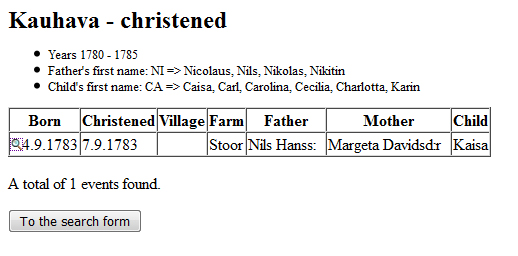
Birth and christening record for Kaisa Nilsdotter Stoor, born September 4, 1783, daughter of Nils Hansson Stoor and Margeta Davidsdotter. This is a HisKi search result.

Although I’d finally put all the pieces together, I couldn’t have done it without Bob’s research and help. It took us over a week. I don’t know how many hours Bob spent on it, but I stayed up into the wee hours on more than one night deciphering digitized versions of centuries old script and following where they led me.

We achieved our goal. I found a lot of good info along the way and conquered my fear of the Finnish Church Records. But I’m not going to be tackling any similar intensive, time-sapping genealogical tasks again any time soon. That’s my intention, anyway.

Bob says the same thing.

But he’s already been gently nudging me to try a new search tool he’s devised.

Friday, October 30, 2015

Cousins in Common: The Rathbuns

Are there even more cousins that David and I are both related to? Yep. I don’t find this surprising anymore. Interesting, you bet. Even fascinating. But not surprising. I wouldn’t be surprised to find coincidences like this and line-crossings in the family trees of many couples.

So which cousins in common am I talking about today?

Norton Galard Rathbun (1838-1919) was my first cousin five times removed. Norton's parents were Saxton Squire Rathbun (1813-1895) and Barbara Elizabeth Huss Rathbun (1816-1894). You can see their gravestone in Bakertown Cemetery, Clyde, Ohio, just below. Norton’s maternal grandparents were Noah Jacob Huss (1790-1843) and Mary Burkholder Huss (1789-1849). You can see Noah and Mary's gravestones in the same cemetery about three-quarters of the way through this previous post. Noah and Mary were my five times great-grandparents through my paternal grandmother’s line.

Gravestone of Saxton Rathbun and Barbara Huss Rathbun.
On Christmas Day of 1865 in Sandusky County, Ohio, cousin Norton married Elizabeth E. Hufford (1842-1926). Elizabeth was David Maxine’s second cousin five times removed. Her great-grandparents were Christian Hoffart (1716-1788) and his second wife Anna Catherine Vogel Hoffart (1715-abt 1807). Christian and his first wife, Elizabeth Keim (1723-abt 1763), were the six times great grandparents of David through his paternal grandmother’s line.

The marriage of Norton Galard Rathbun and Elizabeth E. Hufford Rathbun means that all their descendants are cousins to both David and me. Not that they had a great number of descendants. Norton and Elizabeth had three sons, Edward Carlyle Rathbun (1867-1942), Arthur F. Rathbun (1869-1965), and Herman W. Rathbun (b 1867). Edward had two sons, Irvin Noah Rathbun (1899-1988) and Alan Edward Rathbun (1906-1993). Irvin and Alan had seven children between them, seven great-grandchildren of Norton and Elizabeth Rathbun. One, maybe two, of those didn’t make it to adulthood. None of the remaining five has had any children that I can find so far. All of those offspring are cousins David and I have in common.

Dorothy M. Sherrard Rathbun, 1936.
At one point I thought I might find another family connection though one of these common cousins. Alan Edward Rathbun (1906-1993), grandson of Norton Galard Rathbun, married Dorothy Marguerite Sherrard (1910-1994) in Canton, Stark County, Ohio, in 1936. Since my father has had relatives in Stark County, Ohio, for nearly two hundred years, I wondered whether Dorothy Sherrard was connected to me through another line. But I can’t find that she is.

But there is another family connection among these Rathbuns, David, and me. That connection turns these family lines into one big circle.

A while back I posted here about David's and my cousins in common the Colgrove sisters—Victoria Marie “Vikki” Colgrove Young and Rebecca Louise “Becki” Colgrove Siler. They're related to David through the ancestor they share with him: David F. Sellers (1845-1927). So, like David, they're related to Elizabeth E. Hufford Rathbun through David F. Sellers's maternal line.

I’m related to Vikki and Becki through our common great-great-grandfather Matti Juhonpoika Uhmusberg Hietanen (1857-1915), a line going through my mother. But it's through my father that I’m related to Norton Galard Rathbun, so Vikki and Becki aren’t related to Norton, too, just to Norton's wife, Elizabeth.

But just as David and I are related to all Norton and Elizabeth Rathbun’s descendants, so are Vikki and Becki.

Is that too confusing?

It’s easier to visualize, so I’ve created a chart. The names in red are cousins in common. I didn’t want to make the chart any more complicated than it is, so I didn’t put in the children of brothers Irvin and Alan Rathbun--although those children are also cousins in common with both David and me. If you trace the main course of the lines and ignore the offshoots to the red names, you can see that it’s actually a closed loop.

Cousins in Common: The Rathbuns Chart. As with all images on this blog, click it to see a larger version.

Sunday, September 13, 2015

Frustrating Finnish DNA

As I mentioned in a previous post, I took an autosomal DNA test recently and was curious and excited to find out where the results would lead me. Since I took the test, several genealogical websites have provided me lists of DNA matches to other people.

The first three names on the list of matches that Ancestry.com gave me were all names of cousins I already had on my family tree, all three on my mother’s side. One of these cousins I’ve never met, but the other two I’ve met in person and enjoyed spending time with.

But that was nearly where the navigable connections stopped on my mother’s side. I’ve been able to laboriously sift through my DNA matches and add a number of previously unrecorded relatives to my father's side of the family tree. But discovering new connections to my mother’s side through DNA matches is nearly impossible.

My mother is of Finnish descent. Three of her grandparents—Matti Hietanen, Jr. (1883-1921), Edla Sussana Salo Hietanen (1884-1961) and Mattias Vihtori Stuuri (1888-1981)—were born in Finland and immigrated to the USA as children. Her fourth grandparent, Wilhelmina Elizabeth “Minnie” Hirvi Stuuri (1890-1946), had parents who were both born in Finland and immigrated to the USA as young adults—Wilhelm Heikkinpoika “William” Hirvi (1865-1949) and Wilhenmina “Minnie” Oberg (1865-1945).

Thanks to extensive international research by other family members, especially my cousin Bob Hietanen, the ancestry of my great-grandfather Matti Hietanen, Jr., is known to a great extent. Other cousins, particularly Jaakko Heinimäki, have provided a lot of ancestral research on my great-great-grandfather Wilhelm Hirvi. (These are my sources for the information that I’m a direct descendant in two lines from sixteenth-century Finnish freedom-fighter Jaakko Ilkka.) But for the rest of my Finnish lines I only know a few generations earlier than my great-great-grandparents at best.

I’d hoped that my DNA test would help reveal more of my Finnish relatives and forebears. But there turns out to be an obstacle I didn’t expect. Up through the nineteenth century the Finns had an unusual custom. The surname of a Finnish family was the same as the name of the family’s farm. When a family moved from one farm to another, the family changed its surname to match the new location. This makes genealogical research based on surnames maddening.

This custom is evident in my family tree. For instance my nine times great-grandfather Heikki was born with the last name Punkari in about 1606. At some point he moved, evidently to the Reini farm, and gained the last name Reini. His son Yrjänä, my eight times great-grandfather, was born with the surname Reini about 1660. Evidently he moved about 1685 to the Karhu farm and took that name. His son Esaias, my seven times great-grandfather, was born there about 1704 and evidently remained living there, since he retained the surname Karhu.

In Finland during those days, if a man married a woman and moved to her home, the man took his wife’s last name, since that was the name of the place where he now lived. That’s what happened when my five times great-grandfather Elias Matinpoika Karhu (1760-1809), who was born with the surname Kujala, married my five times great-grandmother Margareta Andersintytär Uhmusberg (1765-1846). For a few generations after that, this line of the family kept the surname Uhmusberg (pronounced Oomsperry), until my great-great-grandfather Matti Juhonpoika Uhmusberg (1857-1915) ended up with the surname Hietanen.

Matti Juhonpoika Uhmusberg Hietanen (1857-1915).
What prompted that name change? No one’s completely sure. But other family researchers have proposed what seems a likely reason. In 1881 Matti Uhmusberg’s elder sister Maria Uhmusberg (1856-1935) married Jaakko Hermanninpoika Aittanen and moved to the Renko farm where there was a cottage named Hietanen. It’s possible that Matti at one point lived in the cottage on his sister’s farm and took the surname Hietanen from the cottage before he emigrated to the USA in 1887.

Comparing family trees to find common last names among ancestors is the main way to figure out how I’m related to other people who match my DNA. I’ve found a couple family trees of DNA matches that have names and dates corresponding to names and dates on my mom's side of my family tree. If I can trust their research, I believe that I’ve found our exact lines of connection.  But finding the line of connection for a DNA match on my mom's side is rare. The custom of changing last names among the Finns makes it anywhere from difficult to impossible to figure out my connections to DNA matches who have Finnish last names or Finnish backgrounds.

Complicating the last name problem is the fact that a Finn whose last name appears in my family tree might have no connection to my family. That person—or an ancestor—might simply have once lived on the same farm as my ancestor. Juuso Hietanen, the Finnish ice hockey star in the 2014 Sochi Olympics, has the same last name my mother grew up with, but he's probably no relation to me.

All my Finn lines come through the Finnish towns of Ylistaro, Kortesjärvi, and Isokyrö, and my maternal grandparents and great-grandparents were all from Fairport Harbor, Ohio. When I find a DNA match who lists an ancestor who was born, married, or died in any of those places, I feel as if we’re oh-so-close to connecting. Is that name a sister, a brother, a cousin, or some sort of blood relation of one of my Finnish ancestors? I long to make the connection, but the name of a town isn’t enough. Without more information, there’s no way to do it. Like Tantalus reaching to pick a luscious fruit in Hades, I can’t reach far enough. The branch is always just beyond my grasp.

It’s not as though my DNA results haven’t listed many people of Finnish descent who are related to me. There are plenty of them—with ancestors named Myllykoski and Walkkila, Niemi and Luoma, Sillanpaa and Rintamaki, and more. But they’re like puzzle pieces that don’t quite fit together. These puzzle pieces are lying in plain sight, and I’m sure they’re pieces from the same puzzle I’m working on. But the pieces that connect them are missing.

Maybe one day DNA research will be able to pinpoint connections among relatives with much more accuracy. But until that day, I'll just have to live with the frustration.

Tuesday, February 17, 2015

My Mayflower Ancestors

The Mayflower in Plymouth Harbor, William Halsall, 1882.
Crossing the Pond

I’ve mentioned in previous posts several distant family connections to passengers aboard the Mayflower, the ship famous for one particular crossing of the Atlantic Ocean. It carried along with its crew a group consisting of religious Separatists, who disagreed with the Church of England, and English merchants with their families and servants. The Mayflower sailed from Plymouth, England, on September 6, 1620. In mid-November of that year it came within sight of Cape Cod in present-day Massachusetts.

Before venturing ashore, most of the male members of the group signed an agreement known as the Mayflower Compact, by which they would govern themselves in the colony they founded at the spot England’s King James I had named New Plymouth. The first winter was hard on the colonists. Death from disease and hardship claimed more than half of the one hundred and two passengers. In the spring of 1621 the survivors stepped onto Plymouth Rock. Shortly afterward the Mayflower, its crew diminished by disease, bade farewell to the colonists and returned to England.

The Plymouth Colony struggled for survival, but with the cooperation of the Wampanoags and other native Americans, they were able to celebrate their first anniversary in the New World. That celebration is still commemorated in the USA on the final Thursday of each November, the holiday known as Thanksgiving.

Mayflower by Marriage

While researching my genealogy I’ve discovered quite a few connections by marriage to Mayflower passengers. Here are those I’ve found.

Catharine Rathbun Huss (1818-1894).
Catharine Rathbun (1818-1894), five-times-great granddaughter of Mayflower passenger George Soule (1597-1680), married Christian Huss (1815-1864), my five-times-great uncle.

Samuel Rider (abt 1601-1679) and Anne Gamlett Rider (abt 1605-1695), my eleven-times-great grandparents, arrived at Plymouth Colony between 1636 and 1638 and settled there. A number of their descendants married descendants of Mayflower passengers, as follow:

Hannah Harlow (1720-1792), great-great granddaughter of Samuel and Anne Rider, married Ebenezer Sampson (1716-1808), a direct descendant of no less than four Mayflower passengers: Myles Standish (1584-1656), Priscilla Mullins (1602-1685), John Alden (1598-1687)—all three immortalized by Longfellow’s poem The Courtship of Miles Standish—and Henry Samson (1604-1684).

Hannah Rider, great-great granddaughter of Samuel and Anne Rider, married Josiah Bradford (1724-1777), great-grandson of William Bradford (1589-1657), Mayflower passenger and second governor of Plymouth, Massachusetts.

William Bradford’s seven-times-great granddaughter, Rena Ann Newcomb (1883-1938), married my great-great uncle Charles Thomas Shanower (1882-1952), not a Rider descendant.

Samuel and Anne Rider’s son Samuel Rider (abt 1632-1715), my 11-times-great-uncle, married Sarah Bartlett, granddaughter of Mayflower passenger Richard Warren.

Roy Robert Grant and Hilda Lucille Stafford Grant.
Other descendants of Richard Warren, sisters Hilda Lucille Stafford (1898-1973) and Helene Thelma Stafford (1902-1985), married Roy Robert Grant (1897-1988) and Charles Elwood Grant (1900-1945) respectively, first cousins to each other and second cousins twice removed of mine. These Grants were both seven-times-great grandsons of Samuel and Anne Rider. I discussed the Grants and Staffords in a previous blog post here.

Richard Warren’s five-times-great granddaughter Mary “Polly” Knowles (1806-1879) married Silas Rider (1803-1871), three-times-great grandson of Samuel and Anne Rider. The same Silas Rider, my third cousin six times removed, was also the four-times-great grandson of Mayflower passengers Stephen Hopkins (abt 1580-1644) and Elizabeth Fisher Hopkins (abt 1595-abt 1643).

Stephen and Elizabeth Hopkins have other Rider connections by marriage. Their great-great granddaughter Desire Godfrey married Nathaniel Ryder (1705-?), Samuel and Anne Rider’s great-grandson. Stephen Hopkins’s great-great-great granddaughter Mehitable Snow (1731-1813) married Reuben Ryder (abt 1717-?), great-great grandson of Samuel and Anne Rider. And Stephen and Elizabeth Hopkins’s great granddaughter Elizabeth Pierce (1737-?) married Gershom Rider, great grandson of Samuel and Anne Rider.

The just-mentioned Elizabeth Pierce was also the great-great granddaughter of Mayflower passenger Edward Doty (abt 1599-1655), a servant of Stephen Hopkins.

I also have non-Rider connections to Edward Doty. His great-great-great grandson Aaron Doty (1807-1843), married my five-times-great aunt Polly Grandy (abt 1805-1838).

Celia Hietanen Woodland as a schoolgirl.
Ellis Doty (1861-1895), Edward Doty’s six-times-great grandson, was the first husband of Alta Lucinda Flowers (1870-1929). After Ellis Doty died, Alta and her second husband had a son Homer Floyd Woodland (1898-1959). Homer married two great-great aunts of mine, Ida Justiina Salo (1894-1967) and Celia Hietanen (1902-1925). You can read about Homer and his wives in this previous blog post.

Homer Woodland is also reputed to be an eight-times-great grandson, through his mother’s mother, Maza Rowley Flowers (1835-1910), of Mayflower passengers Edward Fuller (1575-1621) and his wife, whose name is unknown.

There may well be other marriages that I’m not aware of between my blood relatives and Mayflower descendants.

Fuller and Sons

Over the years, I’ve wanted to find more than simple marriage connections to Mayflower passengers. I’ve been hoping to stumble across a direct Mayflower ancestor.

I may have done that. The Mayflower passengers I mentioned just above—Edward Fuller and his wife—seem likely to be my eleven-times-great grandparents. I'm not absolutely certain of that because there's a weak link the in the chain of descent.

The first few generations descending from Edward Fuller and his wife have been established by decades of research by others into Mayflower passenger genealogy. Edward Fuller and his wife were part of the Separatists who moved from England to Leiden in the Netherlands in order to practice their form of Christianity. After several years in Leiden, members of the Separatist community formed the plan to move to the New World where they wouldn’t have to worry about their children being absorbed into the Dutch community of the Netherlands. Edward Fuller with his wife and younger son Samuel (abt 1608-1683) decided to go along. Edward Fuller’s brother, also named Samuel Fuller (abt 1580-1633), joined them on the Mayflower as physician. Brothers Edward and Samuel Fuller both signed the Mayflower Compact. Edward Fuller’s elder son Matthew, stayed behind, probably in England, and arrived with his wife and family in the Plymouth Colony on a later ship.

Both Edward Fuller and his wife were among the many Mayflower passengers who died during the first winter in Massachusetts. Their son, Samuel Fuller, survived and lived with his uncle Samuel’s family in the Plymouth Colony.

Samuel, son of Edward Fuller, married Jane Lathrop (bef 1614-bef 1683). One of their children was John Fuller (abt 1655-1726), who married Mehitabel Rowley (1660/61-abt 1732), and lived in East Haddam, Middlesex County, Connecticut. Mehitabel was a granddaughter of Matthew Fuller, the elder son of Mayflower passengers Edward Fuller and his wife, and so a first cousin once removed to her husband John Fuller. Church records from East Haddam provide information that one of John and Mehitabel Fuller’s children was Shubael Fuller (abt 1684-1748), who married Hannah Crocker. One of Shubael and Hannah Fuller’s children was Shubael Fuller, Junior, (1721-abt 1800), who married as his second wife Sarah Chapman.

Uh-oh, Jethro

Up to this point the line of descent from Edward Fuller and his wife is firm, proven primarily by wills and church records. Beyond this, the evidence for further descent grows scanty. The book Genealogy of Some Descendants of Edward Fuller of the Mayflower by William Hyslop Fuller, published in 1908 (hereafter referred to as Descendants of Edward Fuller), claims that Shubael Fuller, Jr., had a son Jethro Fuller (1770-1821).

This Jethro Fuller was Shubael, Jr.’s second son named Jethro. The first Jethro is attested in church records from East Haddam, Connecticut. Descendants of Edward Fuller claims the first Jethro died young. The idea of naming a child the same name as a previously deceased sibling might seem dubious. But this naming custom was common in the eighteenth and nineteenth centuries. I’ve run across so many instances of it that I don’t find it unusual anymore. So there’s no reason there couldn’t have been a second Jethro Fuller, son of Shubael Fuller, Jr.

I’ve found apparent geographical links between Jethro and other Fullers who seem to be his family. The 1810 US Federal Census records a Jethro Fuller and household of eight others living in Lenox, Berkshire County, Massachusetts. Descendants of Edward Fuller says that Jethro died in Lenox, Massachusetts. Lenox was also the dwelling place of Jonathan Fuller, clearly a son of Shubael Fuller, Jr., as attested in East Haddam, Connecticut, church records. Both Jethro and Jonathan were also from Dawes Grant, a tract of land in Hawley, Massachusetts, where Jethro married Siba Kelsey in 1795. Other sons of Shubael Fuller, Jr., linked by Descendants of Edward Fuller to Lenox and Savoy, Massachusetts, were Jedediah and another Shubael. Eliezer Fuller had property exchanges in Massachusetts with Jonathan Fuller and Shubael Fuller. The idea that these Fullers were all brothers of Jethro, as Descendants of Edward Fuller claims, is well within the realm of possibility.

Town records of Savoy, Massachusetts, give two sons of Jethro and Siba Fuller: Japheth, born December 29, 1790, and Lorin, born February 8, 1798. That’s where the more-or-less documented chain of descent ends for this line descended from Mayflower passengers Edward Fuller and his wife.
Jethro Fuller and Siba Kelsey Fuller's children listed in Genealogy of Some Descendants of Edward Fuller of the Mayflower by William Hyslop Fuller, 1908.

Loring vs. Lorin

Elma Louisa Conkey Grandy, June 1, 1930.
But can I connect that line to my known ancestors? Let's see.

My great-great-great grandmother was Elma Louisa Conkey Grandy (1835-1934), grandmother of Adella Cecil “Dell” Grandy McElroy Evans Hundhammer (1888-1974)—who I wrote about in this blog post—and mother of Millard Curtis Grandy (1867-1941).

Elma’s maternal grandfather was named Loring Fuller (1798-1863). Census records, other written sources, gravestones, and the fact they and many of their immediate family members lived in Chatham, Medina County, Ohio, support this.

What are the chances that Elma’s grandfather Loring Fuller and the Lorin Fuller reported to be the four-times-great grandson of Mayflower passengers Edward Fuller and his wife are one and the same? This is the weak link I mentioned above.

Let’s examine the evidence for these two Fullers.

Spelling of names:

One is spelled with a “g”—Loring. The other isn’t—Lorin. Yes, they’re different, but only slightly. In a time when many Americans were illiterate and the spellings of words hadn’t been standardized, I’m not sure that the difference in these Fuller first names is significant.

Place of birth:

In the 1850 and 1860 US Federal Censuses, my certain relative Loring Fuller, who lived in Chatham, Medina County, Ohio, was recorded to have been born in Massachusetts. An entry for Loring’s son-in-law George Melton in the 1889 book Biographical Souvenir of the State of Texas lists Loring as being from Massachusetts. That information is in general agreement with information about Lorin Fuller, the son of Jethro Fuller, who was recorded to have been born in Savoy, Massachusetts. 

1860 US Federal Census listing for Loring Fuller and family in Chatham, Medina County, Ohio. Remember you can click on any image to see it larger.

Date of birth:

The gravestone of Elma’s grandfather Loring Fuller stands in the Chatham Township Cemetery in Chatham, Medina County, Ohio. Here’s a photo of that gravestone. It gives Loring's death date as March 17, 1863, and his age at death as sixty-five years, one month, and eight days. That would make Loring Fuller’s birth date February 9, 1798. That date doesn’t match the birth date of Lorin Fuller, son of Jethro Fuller, which is February 8, 1798. But notice that the difference between them is a single day.

Other possible evidence for Loring Fuller, grandfather of Elma:

The 1840 US Federal Census lists a Loren Fuller living in Sullivan, Lorain County, Ohio. “Loren” is another spelling, but is this individual the same as either Loring or Lorin? There’s no sure means to tell. This Loren is between forty and fifty years of age, and any Loring born in 1798 would be about forty-two. So that matches. There’s a white female between thirty and forty years of age. This agrees with Loring Fuller’s wife who was born in 1801 and would be about thirty-nine in this 1840 census. Her name is variously spelled Orpha, Orphila, and Orphilia. Her maiden name is unknown. However, the age ranges listed for the other people in this 1840 census mostly match the records I have of Loring and Orphila Fuller’s children, but not exactly. There are also discrepancies in the number of them and their genders.

Jonas Chilson Conkey and Mary Loretta Fuller Conkey.
The 1830 US Federal Census lists a Loring Fuller living in Nichols, Tioga County, New York. Here the children exactly match the number, genders, and age ranges in my records for Loring and Orphila Fuller’s children. Also, Loring and Orphila’s first three children, including my four-times great grandmother Mary Loretta Fuller Conkey (1824-1877), were all born in the state of New York, where this Loring Fuller and his household were living. But this 1830 census lists both the adult male and adult female in the household as being between forty and fifty years of age. This doesn’t match with my relative Loring, who’d have been about thirty-two, nor with his wife Orphila, who’d have been about twenty-nine.

These two censuses, 1830 and 1840, might be the right Loring if the census-taker recorded inaccuracies. The censuses might record the necessary path of Loring and his family from Massachusetts through New York to Ohio. But they might not.

Too Many Lorings

There was another Loring Fuller, a son of Zephaniah Fuller, who was born in Kingston, Massachusetts, in 1789. He was a descendant of Samuel Fuller, the Mayflower physician brother of Edward Fuller, and a distant cousin to Lorin Fuller, son of Jethro. For a while I suspected that my five-times-great grandfather Loring Fuller might be the same as this Loring Fuller of Kingston. But I’ve come to discount that possibility because the birth dates of the two don’t match at all. There are still sites on the internet that conflate them, however.

But I don't want to conflate my Loring with Lorin, Jethro's son, if they were not the same person. If they weren't, are there any traces of Lorin, Jethro's son, that would disprove it? Other Loring Fullers, who were alive at about the right time, include:

A Loring Fuller was born 1800 in New York, as recorded in American Genealogical-Biographical Index, volume 59, page 349; and a Loren Fuller was born 1800 in New York, as recorded in American Genealogical-Biographical Index, volume 59, page 349. I suspect these two are the same person. He's possibly identical with Lorin Fuller, son of Jethro Fuller, although there’s a discrepancy between this Loring/Loren Fuller’s New York place of birth and Lorin Fuller’s evident birth in Massachusetts. And he's also possibly identical with Loring Fuller, grandfather of Elma, except for the same birth place discrepancy. The birth year is slightly off, too.

A Loring Fuller and wife Betsey had son Philo S. Fuller in 1827. Philo Fuller died in Springfield, Massachusetts, in 1876, so it’s quite possible that his father Loring was the son of Jethro Fuller born in 1798 in Massachusetts.

A Loring Fuller and wife Laura had daughter Caroline A., born in Berkshire, Massachusetts, about 1827. It’s possible that this Loring was the son of Jethro Fuller, especially since Savoy, Massachusetts, where Jethro’s son Lorin was born is in Berkshire County, the same county where this daughter Caroline died.

I have no record that my five-times-great grandfather Loring Fuller had any child named either Philo or Caroline. There are no records that he was married to either a Betsey or a Laura. So if either of these two previous Lorings is identical with Lorin, son of Jethro, then the chain of descent doesn't connect. But I've found nothing to suggest that either of these other Lorings was, in fact, a son of Jethro Fuller. So this evidence is inconclusive.

There are many other Loring/Lorin/Loren Fullers recorded at various times and places in North America, but they all have birth years so distant from 1798 that I have discounted them from consideration.

Conclusive or Not?

So after sifting the available evidence, what is the chance that my five-times-great grandfather was the son of Jethro Fuller? They had a similar name. They had the same general birthplace. They had a similar birth date. In the end, it's that birth date, with a discrepancy of a single day, that I believe means they were almost certain to have been the same person.

A cousin of mine who has done years of research on this family line doesn’t accept that our ancestor Loring Fuller is the same as Lorin, son of Jethro Fuller, because there is no proof. I agree there isn’t proof. But the evidence weighs so heavily in favor of them being the same person that I accept the idea as true.

Of course, there’s a bit of wishful thinking in my acceptance—because if it’s true, then I’m a direct descendant of Mayflower passengers Edward Fuller, his unnamed wife, and their son Samuel.

That means I’m also related by blood to Edward’s brother Samuel Fuller, the Mayflower physician. That opens up a whole new slew of marriage connections to other Mayflower passengers, including Francis Eaton and his wife Sarah, their son Samuel Eaton, John Billington (the first murderer in the Plymouth Colony) and his wife Elinor, their son Francis Billington, and John Howland (who fell off the Mayflower in a storm and was rescued).

It also means I’m related by blood on my father’s side to Homer Floyd Woodland, who married two of my great aunts on my mother’s side.

So I conclude that I'm related by blood to four Mayflower passengers and have connections by marriage to fifteen more. I’ll take it.

Idealized painting of the first Thanksgiving by Jean Leon Gerome Ferris.

Monday, January 19, 2015

My Famous Relatives: Jaakko Ilkka

The 1978 premiere of the opera Jaakko Ilkka by Jorma Panula, with Tuomo Häkkilä, center, in the title role

Most people in the USA won’t recognize the name Jaakko Illka. But in Finland he’s a well-known folk hero, the leader of the Cudgel War of 1596.

I know the name Jaakko Ilkka because he’s my eleven-times-great grandfather, at least according to research by a Finnish cousin of mine. Finnish church records, which have been the legal repositories of birth and marriage announcements, are all that researchers have to rely on. Those records seem to confirm two lines of descent from Jaakko Ilkka to proven ancestors of mine on my mother's side.

One line of descent comes down through my great-grandfather Wilhelm Hirvi, who I’ve written about on this blog before. You can hear a recording of him singing here. 

The other line of descent comes down through my great-great-grandfather Matti Uhmusberg Hietanen, who I’ve written about on this blog here.

Sigismund III by Pieter Claesz. Soutman
In the late 16th century Finland was a part of Sweden under King Sigismund III.  Sigismund lived in Poland, which he also ruled, so to oversee Finland he appointed a governor, Klaus Eriksson Fleming. At the same time Sweden was overseen by Sigismund’s uncle Kaarle. Governor Fleming of Finland and Duke Kaarle of Sweden did not get along. They vied for power, often at the expense of the poorest of the Finnish peasants.

The people of the Ostrobothnia region of central Finland resented the feudal military tax imposed to help pay for Sweden’s war with Russia. The Ostrobothnians had been legally exempted from this tax during the reign of Sigismund’s father, in return for their defense of Ostrobothnia against the Russians. But when Sigismund took the throne, the exemption was ignored. Crushing taxation—collected, often brutally, by Governor Fleming’s military—only added to the Finnish peasants’ woes, which already included the loss of men drafted to defend the border and poor harvests of the little ice age.  In some places the peasants faced starvation. Small rebellions broke out from time to time, but the taxation continued.

In 1585 Jaakko Ilkka (1545-1597), a farmer, lived with his wife and son in Ilmajoki in Southern Ostrobothnia, Finland. He bred cattle on his farm and became a merchant, shipping his cattle to Sweden. From 1586 through1588 he served as the second sheriff of Ilmajoki. This position increased his prestige and his income. He flourished and became the seventh richest merchant in Southern Ostrobothnia, managing shipping to Sweden, Estonia, and elsewhere.

His first wife died about 1588. He re-married and eventually had three more sons.

In 1591 Jaakko Ilkka joined the army. As a member of the military he was tax-exempt and collected feudal taxes. He participated in three expeditions in Sweden’s war with Russia. By 1593 his military activity stopped. He collected no more taxes from his peasant neighbors. In 1592 Governor Fleming declared a trade embargo in the Gulf of Bothnia. Merchant shipping in the Gulf of Bothnia virtually ceased. Ilkka concentrated on cattle farming.

By late fall of 1594 Sweden and Russia began negotiations to end their war. To support the negotiations Governor Fleming had Swedish troops transported to Finland. The Finnish people, already crushed by military taxes, refused to pay the Swedish forces’ costs. Fleming ordered the military to force collection.

On May 18, 1595, the Treaty of Teusina ended the twenty-five-year Russo-Swedish War. Despite the war’s end, Fleming’s militia continued to collect the feudal tax. Fleming wanted the revenue in order to combat Duke Kaarle’s efforts to take the Swedish crown. But this meant little to the Finnish peasants who lived in fear of being robbed, tortured, and having their homes burned if they could not pay.
Duke Kaarle, later King Charles IX of Sweden.

By late 1595 Duke Kaarle of Sweden was denouncing the oppression of the peasants by Fleming and his military. Encouraged by this, the entire population of Finland’s Ostrobothnia region refused to pay their butter tax.  A small force of Finnish peasants approached Jaakko Ilkka with the idea to take back the grain that had been collected as tax since the end of the war. He agreed to lead them.

On December 24, 1595, while the military was preoccupied with Christmas celebrations, the rebels attacked the Swedish cavalry in Isokyro and Rautalampi. They recovered their grain and drove the soldiers out of the region. But by mid-January 1596, the Swedish military had suppressed the rebellion and arrested Ilkka. He was imprisoned in Turku Castle in Turku, Finland.

Ten months later he escaped. One story says that a draft in his cell led him to a sewer duct that he crawled through to freedom. But the actual duct at Turku Castle is too small for a man to fit inside. Another story says he used a concealed knife to pick mortar from between the stones of his cell wall. He used the holes to climb the wall, then let himself down the other side with a rope made from his coat. A more plausible explanation is that friends, sympathizers, or possibly his second wife’s relatives used their influence to free him.

Unrest among the Finns grew. On November 15, 1596, St. Catherine’s Day, Duke Kaarle sent an emissary to a gathering at the church in Isokyro, Finland, urging the people to fight for their rights. He also sent a shipment of distilled spirits. The men at the church decided to stop paying the feudal tax and to defend themselves with arms. They gathered a small resistance army from all over Finland and named Ilkka their leader. In mid-December three groups of these fighters set out marching south by different routes toward Turku. Jaakko Ilkka and Yrjo Kontsas led the main group of about eight hundred, looting and burning soldiers’ farms and crown-owned properties and gathering adherents along the way.

The spiked cudgels carried by many of the peasants were effective weapons in piercing soldiers’ armor. These instruments gave their name to the rebellion, the Cudgel War—or as it’s known in Finland, Nuijasota.

On December 26, Ilkka and his men, now about 2500 strong, defeated a party of two hundred cavalry soldiers and set up camp in Nokia. On December 31, Governor Fleming attacked the rebels with his army of over 3000 professional soldiers and several cannons. The rebel army defended themselves successfully.

During the night Fleming, having failed to defeat the rebels and realizing that other groups of rebel reinforcements were coming, sent emissaries into Nokia to treat with the rebel leaders. The emissaries offered an end to the feudal tax and safe passage home for the rebels. In exchange they demanded the rebel leaders, particularly Jakko Ilkka. Fearing betrayal, Ilkka and several others fled on horseback into the night.

Now unable to fulfill Fleming’s demands, the rebel army broke up and began to flee. Fleming’s cavalry attacked the fleeing peasants and a massacre was on. Other groups of rebels were also defeated by the military. Peasants were slaughtered until one local governor pointed out that dead peasants could not pay taxes.

Jaakko Ilkka returned to Ilmajoki where he was captured by his neighbors. He was turned over to local governor Abraham Melkiorinpoika, who had orders to transport Ilkka to face Fleming in Turku. However, Melkiorinpoika feared that rebels would succeed in freeing Ilkka during the long trip to Turku. He staged a quick court martial in neighboring Isokyro. Ilkka and five other rebel leaders were sentenced to death.

Jaakko Ilkka’s exact method of execution on January 27, 1597, is unknown. The standard method of the day was to have the hands and feet crushed, the right arm cut off, and then the head severed from the body.  Ilkka’s parts were publicly displayed in Ilmajoki before the rebel army buried him honorably in the local cemetery.

The rebellion continued. The climactic Battle of Santavuori on February 27, 1597, was a disaster for the peasants. Many were brutally slain. The Cudgel War, one of the largest European peasant rebellions, ended in failure for the oppressed. Governor Fleming died a couple months later. Duke Kaarle, who had given lip service to the rebels’ cause but provided little in actual support, eventually became King Charles IX. But little changed in the lives of the peasants.

Duke Kaarle insults the body of Klaus Fleming in 1597, painting by Albert Edelfelt, 1878.

Jaakko Ilkka, the first Finnish freedom fighter, was hailed as a hero.  His example of a common man rising up to lead the fight against injustice has continued to inspire Finland as a nation.

Jaakko Ilkka monument in Ilmajoki, Finland.
Among the memorials to Jaakko Ilkka is a large monument raised in his home town of Ilmajoki in 1924. In 1978 Jaakko Ilkka, an opera by Jorma Panula with a libretto by Aarni Krohn, was first performed at the Ilmajoki Music Festival. A recording of the opera was released in 1979.  A Finnish television production of the opera was broadcast in 1982. The legacy of the Cudgel War has continued in literature, art, and academic studies. Each year since 2003 The Cudgel War has been reenacted at a camp in Kavalahti, Inkoo, Finland. In 2004, viewers of the Finnish television show Great Finns (Suuret suomalaiset) voted Jaakko Ilkka number 75 of the 100 greatest Finns of all time. 

I have no means to double-check the genealogical research that says Jaakko Ilkka is my forebear since I don’t speak or read Finnish and don’t have easy access to the records. But I’m happy to accept my descent from Jaakko Ilkka as true.