Sunday, December 6, 2015

Life of Lucille

My grandmother Verna Lucille Evans Shanower Cote died a week ago at the age of 99 1/2.  She hated the name Verna and was always known as Lucille. Her laugh was wonderful.


She was born May 31, 1916, in Cleveland, Cuyahoga County, Ohio.

Lucille with her father Joseph Edward Evans.

Her father was Joseph Edward Evans, son of Welsh immigrants to the USA.

Lucille with her mother Adella Cecil Grandy Evans Hundhammer.

Her mother was Adella Cecil Grandy, whose early English immigrant ancestors included Mayflower passengers.

Lucille with her grandmother Bertha May Flora Grandy.

Lucille’s parents divorced when she was four years old. Her father mostly vanished from her life. Lucille was raised primarily by her maternal grandmother, Bertha May Flora Grandy.

Anna Belle Stratton, Bertha May Flora Grandy, Dell Grandy Evans Hundhammer, Elma Helene Grandy, Bruce Grandy, Jessica Stratton Grandy, Lucille Evans.

Lucille Evans and Stanley Shanower.

Her mother remarried and the family moved to Mentor, Lake County, Ohio. In school Lucille met Stanley Raymond Shanower.

Lucille and Stanley.


Mentor High School senior portrait, 1934.

Modeling headshot.
Modeling headshot.


After graduating high school Lucille attended modeling school.


Her modeling career stopped when she married Stanley Shanower on April 17, 1938.

Newlyweds, June 1938.


Lucille subsequently worked at the nursery Wayside Gardens in Mentor. She was her husband Stanley’s partner in all of his business ventures, including the Shanower Overnight Farm, a motor hotel; Shanower Electric which serviced refrigeration and air conditioning; and McGarvey’s Beachcomber, a restaurant in Grand River, Ohio. She raised their three sons.

The Shanower Overnight Farm, Mentor, Ohio.


A son's wedding, 1967.

In the 1960s Lucille went back to school and became a librarian. She took a job at Willoughby-Eastlake Public Library in Willoughby, Ohio.

Lucille and Stanley Shanower.

I'm flanked by my grandparents Lucille and Stanley, Winter Haven, Florida, spring 1983.

She and Stanley retired and moved to Winter Haven, Florida.

March 1984.

Lucille and Stanley with their sons, sons' wives, and grandchildren, December 1986.


Stanley died in 1987. Lucille married her second husband Rene Cote in 1990. Rene died in 2002. Lucille spent her winters in Florida and her summers in Ohio.

Lucille at her 90th birthday party, August 2006.

In 2009 she moved into the Residence of Chardon, an assisted living facility in Chardon, Geauga County, Ohio, near one of her sons and his family. The Residence of Chardon was built on land once owned by the Grant relatives of her first husband Stanley.

The Residence of Chardon, Grandma's final home.

I interview Grandma about family matters in August 2012.

Grandma and I discuss a photo of her great-grandmother Elma Conkey Grandy.

Lucille at one of her favorite restaurants, Red Lobster, March 2014.

The week before Thanksgiving of 2015 she came down with bronchitis. It developed into pneumonia. She died at 12:35 AM on Sunday, November 29, 2015. She had been surrounded by family members all day. Her mind was unimpaired to the end.

Grandma and me in December 2013.

Click here for her obituary.

Click here for an earlier post about the secret marriages of Grandma's parents.

Tuesday, November 17, 2015

Finn Findings

It’s difficult to find Finnish relatives with the results of the Ancestry.com autosomal DNA test—at least, that’s what I claimed in an earlier post here. A cousin of mine read that post about my frustration with the roadblocks and arduous searches required. I don’t think cousin Bob—who’s done amazing work to extend our Hietanen family tree back several centuries—thought it could be quite as grim a situation as I made it out to be.

He e-mailed me to suggest a few strategies. I e-mailed him back with information from my Ancestry.com DNA match list. Bob worked on a couple names. He found the DNA match list cumbersome enough that he looked for online search tools to make it easier to find connections. He even began to develop some search tools of his own. Bob does computer programming, so that’s the sort of thing he can do.

Yet it wasn’t long before he came to a screeching halt. The Ancestry.com model of trying to find connections among DNA matches is so unwieldy as to be discouraging.

But by that time Bob and I both had our blood up to do some serious research.

Previously Bob had sent me links to online Finnish Church Records. These are the official records of births, marriages, deaths, and so on of the Finnish populace for several centuries. Because Finland had no civic entity assigned to gather the information for these records, the church recorded these life landmarks for the Finnish people.

I’d long been intimidated by the idea of Finnish Church Records. I can’t read Finnish. I know about half a dozen Finnish words—things such as sauna (and, yes, I pronounce it correctly—so that it sounds more like sow-na than saw-na). But throw kuulutettujen and muuttaneiden at me and I’m lost. Other family researchers have dug into the depths of the Finnish Church records. I’ve been content to leave the heavy lifting to them and grateful for what they share.

But Bob’s shared a lot of his research with me over the years. I didn’t want him to think I was just slacking off to let others take care of all the hard stuff.

So I looked at one of my DNA matches that had caught Bob’s attention. I’ll call that DNA match “Mitch.” “Mitch’s” family tree was clearly of Finnish descent on his mother’s side. Months ago I’d found the name Luoma on “Mitch’s” tree. I have Luomas on my tree. I’d made a note that Luoma might be the connection between me and “Mitch.” Now I started with the Luoma on “Mitch’s” tree and worked backward. I quickly came across the surname Stoor. Mitch’s Stoor ancestors lived in Kortesjärvi, Finland.

I knew I had one Stor ancestor from Kortesjärvi, Finland—Antti Stor, my great-great-great-grandfather.

I didn’t think the difference in the spelling of the last name—Stoor versus Stor—probably made any difference. In the end, it didn't; they're cognate spellings, along with Storr, and are interchangeable. There’s a lot of variation in the spelling of Finnish names from the seventeenth, eighteenth, and nineteenth centuries. I felt pretty confident that Stoor/Stor from Kortesjärvi was the key to my connection with “Mitch.”

I mentioned this to Bob, then dove headfirst into the Finnish Church Records online at the Finnish Family History Association (FFHA).

Navigating the records wasn’t as hard as I thought it was going to be. On the FFHA site, they’re divided geographically. So I looked up Kortesjärvi and was confronted with a list of Finnish words I couldn’t even pronounce, much less understand.

But Google translate exists for a reason.

I started blindly with the Church Communion records, simply because there were more of them than anything else. This turned out to be a fortuitous accident. The communion records list whole families—the first name and patronymic of father, mother, and children—along with the birth date of each family member. The families are grouped by surname/farm name. Until the twentieth century a Finnish farm name generally equaled a surname, especially in rural communities. So the communion records provided the exact type of information I needed in order to work my way back a generation at a time.

I began with the surname/farm name of Stoor/Stor in Kortesjärvi and soon found my great-great-great-grandfather Antti Stor, born December 10, 1835.

Of course, Antti’s name wasn’t recorded with that spelling. Sweden ruled Finland for a long time. Swedish became the official language of Finnish records. Finnish first names have Swedish versions. Finnish patronymics, based on first names, also have Swedish versions. Instead of Antti Matinpoika Stor, I found Anders Mattsson Stoor. His parents and siblings were listed with him.

One of the several Finnish communion records showing Anders (Antti) Stoor (fifth name, preceded by the word "Son"), born December 10, 1835. His father Matthias Gustafsson Stoor (first name) was born July 10, 1802, in—as noted in the third column—Palojärvi.

From there it wasn’t too difficult to go back another generation. But what was this? In an earlier communion record, Antti’s father, Matthias Gustafsson, born 1802, had the word Palojärvi following his birth date. He’d been born on the Palojärvi farm, not the Stor farm. I pushed back another generation, but the name Stor had completely disappeared from this line of descent.  Dead end.


Communion record for Gustav Johanisson Palojärvi (bottom name), born October 12, 1760, father of Matthias Gustafsson, with his parents, Johan Johanisson Winikainen Palojärvi (first name), born December 26, 1730, and Maria Matthiasdotter (second name), born May 12, 1729, and other family members. No sign of Stoor/Stor here.

So I went back to Matthias Gustafsson, born 1802. I figured that his wife, Maria Andersdotter, born 1801, must have been the Stor.

At the same time I was combing the communion records on the FFHA site, cousin Bob had been delving into the Finnish Church Records at the online HisKi project of the Genealogical Society of Finland. Bob was also trying to find the connection between me and “Mitch.” The HisKi project has fewer online Finnish Church Records than FFHA. But HisKi has some different records and best of all, the HisKi project has a search function in English.

Bob found that Matthias Gustafsson’s wife Maria Andersdotter, who hadn’t been a Stoor/Stor before marriage, had been a Försti. I dug around and pushed back a couple generations up the Försti tree. No Stoor/Stor appeared there. Another dead end.

I subsequently hit a few more dead ends looking for a Stoor/Stor connection between “Mitch’s” family tree and mine. Despite the Stoor/Stor dead ends, all this research Bob and I were doing was nevertheless productive. It filled in previously unknown branches of my family tree. All these people were my relatives, even though most of them weren't Stoor/Stors. And I was successfully navigating the Finnish Church Records.

I went back down the line to my great-great-grandfather, Matti Nikolai Stuuri (1861-1922), son of Antti Stor, who had immigrated to the USA from Finland in 1889. He’s the one who changed his surname Stor to Stuuri in his new country. The reason for the change is not apparent. The story I’ve received is that Stor was an unfamiliar last name and Stuuri was more comprehensible to the inhabitants of Fairport Harbor, Lake County, Ohio, because there was another Finnish immigrant family there named Tuuri. That seems like nonsense to me—Stor seems much simpler than Stuuri—but I wasn’t around at the time. Maybe it made sense then.

Anyway, Matti Nikolai Stuuri’s wife was Wilhelmina “Walpori” Erkkilä (1860-1925). Could she have brought the Stor name into the family? I pushed back through the Finnish Communion archives for two generations, tracing the Erkkilä/Erkilä name. No luck finding any reference to Stoor/Stor.

Communion record for Wilhelmina "Walpori" Johansdotter Erkilä (fourth name), born March 13, 1860, in Kauhava, with her parents and siblings.

Finally, the only branch I hadn’t explored was that of Antti Stor’s wife, Caisa Lena, whose last name before marriage was unknown to me. But I had her birth year, 1842. A HisKi search gave me her birth record, which had her parents’ names, which led me to their marriage and communion records. (Surprisingly, Caisa Lena’s surname before marriage had been Tuuri. Maybe this was part of the inspiration for her son’s change of name from Stor to Stuuri.)

Caisa Lena’s parents had lived on the Stor farm at one point. A lead! I couldn’t push her father’s line back any further. Her mother Elisabeth had been born on the Back farm, and Elisabeth’s father was also a Back. The only opening remaining for the Stoor/Stor name to come down was Elisabeth’s mother, Caisa Nilsdotter Storr, born 1783. Was Caisa Nilsdotter’s father a Stoor/Stor? According to her patronymic his name would have been Nils. But I couldn’t find a Nils Stoor/Stor in the Finnish Church Records.

Meanwhile, cousin Bob had been working on the Stoor names on my DNA match “Mitch’s” family tree. Bob had gotten back to Hans Mattsson Stoor (1707-1776). It seems Hans Mattsson had twenty-three children by two wives, leading Bob to dub him “the Stud.” I looked at Bob’s list of the Stud’s children. In general they were of the generation when Caisa Nilsdotter’s father would likely have been born. But no Nils appeared among the Stud’s children. Another dead end? It seemed so at first.

But among the Stud’s children appeared a Niclaus. By this time I was quite used to the varying spellings and cognates of Finnish first names. I hadn’t run across Nils and Niclaus as cognates, but a quick check of HisKi told me that they were.

That was the key.

I searched the Finnish Church Records for Niclaus Hansson Stoor/Stor and quickly found birth, marriage, and communion records clearly confirming that Niclaus “Nils” Hansson Stoor/Stor (born 1750) and Margeta Davidsdotter (last name unknown) were the parents of Catarina “Caisa” Nilsdotter Stor (born 1783). All the birth dates matched.

Bingo! Hans Mattsson “the Stud” Stoor is the common ancestor of both “Mitch” and me. He’s my seven times great-grandfather through his second wife, Maria Mattsdotter (last name unknown), born 1728. He’s also “Mitch’s” seven times great-grandfather, but through his first wife, Anna Carlsdotter (last name unknown).

Immediately I e-mailed Bob with the news and included screen caps of the relevant records. You can see three of those records below.

Communion record of 1756 for "the Stud," Hans Mattsson Stoor (first name), born May 19, 1707, with his second wife Maria Mattsdotter (second name), eldest son Eric Hansson (third name), daughter-in-law Walborg Mattsdotter (fourth name), and others of his twenty-three children, including his son Niclaus (here written Nicls) Hansson (seventh name), born April 20, 1750.

Communion record for Nils (Niclaus) Hansson Stoor (first name), born April 20, 1750, and his wife Margeta Davidsdotter (second name), no birth date.


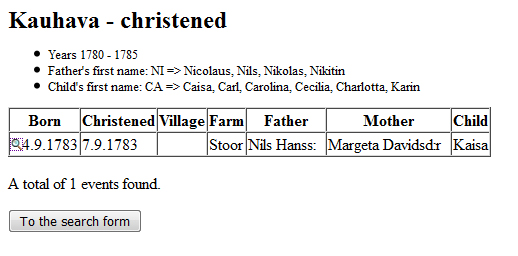
Birth and christening record for Kaisa Nilsdotter Stoor, born September 4, 1783, daughter of Nils Hansson Stoor and Margeta Davidsdotter. This is a HisKi search result.

Although I’d finally put all the pieces together, I couldn’t have done it without Bob’s research and help. It took us over a week. I don’t know how many hours Bob spent on it, but I stayed up into the wee hours on more than one night deciphering digitized versions of centuries old script and following where they led me.

We achieved our goal. I found a lot of good info along the way and conquered my fear of the Finnish Church Records. But I’m not going to be tackling any similar intensive, time-sapping genealogical tasks again any time soon. That’s my intention, anyway.

Bob says the same thing.

But he’s already been gently nudging me to try a new search tool he’s devised.

Sunday, November 1, 2015

Who's Who in the Shanower Family


This photo was taken at a Shanower Family Reunion at the home of my great-great-grandparents Benjamin Franklin Shanower (1845-1928) and Louisa "Lucy" Leifer Shanower (1856-1916). The photo was labeled Shanower Family Reunion, without date or individual identifications. Before I scanned this copy of the photo, another family researcher had sent me a photocopy of it labeled 1899. So I had a date for it.

But could I identify the people? I figured I wouldn't recognize too many of them. I thought I might find Benjamin Shanower and his immediate family, since I have other photos of them. Recognizing the hosts, Benjamin and Lucy Shanower, wasn't hard. And I picked most of Benjamin's children out of the crowd. But the appearances of a couple of those children raised red flags about the date of this photo.

Charles Chalmers Shanower Hinman (1877-1965), son of Benjamin Shanower and Benjamin's first wife Sophia King Shanower (1841-1877), appears in this photo, fifth from the left in the second row (the first row of adults). But as I detailed in an earlier post here, Charles was given up for adoption as a child and wasn't rediscovered by his birth family until late in 1900. Or so newspaper stories reported. Was it possible that those stories were inaccurate? Had Charles been rediscovered earlier, so that he could appear in an 1899 family photo? Complicating this question was the appearance of Charles's wife, Nellie Maude Salsbury Hinman (1873-1955). In the photo, she's sitting next to him, fourth from the left in the second row. I supposed it was possible that they'd attended the Shanower reunion together in 1899, before their marriage on December 12, 1900. But it seemed odd.

I also noticed Ralph Leo Shanower, the youngest of Benjamin and Lucy Shanower's children, who was born April 12, 1895. If this photo was from 1899, then Ralph would be four years old. But Ralph, who's standing on the right end in the back row, is obviously years older than four.

Ralph's apparent age answered the question about Charles and Nellie Hinman's presence. The year was certainly post-1900, the year Charles was rediscovered by his birth family and he married Nellie. This photo could not be from 1899.

So when is the photo from?

That question was easy to answer. I had a record of another Shanower Family Reunion at Benjamin and Lucy Shanower's home—on August 26, 1909. This location and date fit. Benjamin and Lucy are at center in the second row, the logical position for the hosts of the reunion. Ralph Shanower would be fourteen years old in 1909, and he looks about that age in the photo. And Charles and Nellie Hinman had been married for nearly nine years, so their attendance together at the reunion is perfectly reasonable.

The Published Report

Further confirmation of a 1909 date was provided by a published account of the 1909 Shanower Family Reunion, as follows:

SHANOWER FAMILY REUNION
The eleventh annual reunion of the Shanower family was held at the pleasant home of B. F. Shanower and wife of Claridon, Ohio, on the 26th day of August, 1909. At quite an early hour the friends began to arrive and before noon about 105 relatives were present, representing seven different states: Washington, Minnesota, Indiana, Ohio, Michigan, Kentucky and Alabama.

The one surprising feature of the occasion was that for the first time in thirty years the eleven sons and daughters of B. F. Shanower and wife were together.

The forenoon was spent in visiting and making new acquaintances. At noon the dinner was served on long tables under a large tent and consisted of every thing good that heart could wish. Immediately after dinner the guests gathered on the lawn in front of the house and a picture of the group was taken by Photographer Strong of Chardon. The assembly was then called to order by Pres. Simon Kandel, and the audience joined in singing “America” after which the Sec., Miss Nettie Shanower, gave a report of the previous reunion. The Historian, Mrs. Lucy Shanower, gave a very carefully prepared report. A very amusing reading was rendered by Miss Jennie Shanower, a quartette sang an appropriate song. Rev. Cooper gave an interesting address which was enjoyed by all present.

The following officers were elected for the ensuing year: Pres., B. F. Shanower, Burton; Vice Pres., Amos Shanower, Wolcottville, Ind.; Sec., Miss Nettie Shanower, Burton; Treas., N. E. Shanower, Burton; Historian, Mrs. Lucy Shanower, Tontogany, O.

It was decided to hold the next reunion at the home of A. B. Shanower and wife, Tontogany, O., the last Thursday in August. Before the crowd dispersed all joined in singing, “God Be With You till We Meet Again,” and then the pleasant occasion was one to look back upon instead of forward to.

The weather-man was kind, Mr. and Mrs. Shanower did all in their power to make the day enjoyable, and one and all agreed that the day was well spent.
Ben's Kids

Confirmation that this photo is specifically from the 1909 reunion is the reference to the eleven children of Benjamin Shanower being together for the first time in thirty years. All except one of them, the eldest, William Benton Shanower, are in the reunion photo. Not all the "about 105" people at the reunion made it into the photo, which has 89 people.

Although William doesn't appear, I firmly believe he was present that day. Not only does the published account say all eleven of B. F. Shanower's children were there, but I have another photograph of all those children—including William—with Benjamin and Lucy. And most everyone in that other photo is wearing clothing that looks exactly the same as what they're wearing in the big reunion photo. Among the clothing differences are: a couple of the women wearing dark skirts in the reunion photo are wearing white skirts in the other, son Frank has donned a coat for the other photo, and Benjamin Shanower seems to have put on a dark tie in the other photo. But I believe both photos were taken about the same time, possibly the same day.

Here's the "other" photo:

The Benjamin Franklin Shanower family. Seated from left to right: Charles C. Shanower Hinman, Mary E. Shanower Hostetler, Benjamin F. Shanower, Lucy Leifer Shanower, Ralph L. Shanower, Bertha A. Shanower Pollock; standing from left to right: Jennie M. Shanower, David E. Shanower, Katherine O. Shanower Phillips, William B. Shanower, Ella M. Shanower Bower, George E. Shanower, and Benjamin F. Shanower, Jr.

Why isn't William in the reunion photo? I don't know. Maybe he arrived at the reunion too late to be in it.

The report mentions several other reunion attendees that I can't identify in the big reunion photo.

John Amos "Amos" Shanower (1855-1934) of Wolcottville, LaGrange County, Indiana, and Nathaniel E. Shanower (1853-1936) of Burton, Geauga County, Ohio, brother of Benjamin Shanower, and Nathaniel's daughter, Nettie Oleva Shanower (1881-1977), are referenced in the report, but I can't confidently identify them in the reunion photo, although I've made guesses about Nathaniel and Nettie.

The Lucy Shanower, Historian, of Tontogany, Ohio, referenced several times in the reunion report, isn't Lucy Shanower, wife of Benjamin, but instead Lucy Anne Whiteleather Shanower (1860-1942), wife of Ananias Benton Shanower (1857-1920). It's their home where the next Shanower Reunion, in 1910, was to be held. Their identities in the photo are firmly established, thanks to their granddaughter Velma Shanower Kirchner.

I don't think the Reverend Cooper mentioned in the report was a member of the family.

Locations Mentioned

Seven states of the USA are supposed to be represented by the people in the reunion photo: Washington, Minnesota, Indiana, Ohio, Michigan, Kentucky, and Alabama.

Naturally, many of the attendees were from Ohio, where the photo was taken.

A number of people at the reunion were from Indiana, among them Jennie M. Shanower (1875-1942) from Elkhart, daughter of Benjamin and first wife Sophia Shanower, and Amos Shanower from Wolcottville, mentioned in the report.

Mary Elizabeth Shanower Hostetler (1873-1951), daughter of Benjamin and first wife Sophia Shanower attended the reunion from her home in Birmingham, Alabama. She had three daughters by 1909, but I don't think they're in the photo. I think Mary's husband, Christian K. Hostetler (1865-1935), didn't attend the reunion either.

Charles and Nellie Hinman were the attendees from Saint Paul, Minnesota.

William Benton Shanower, eldest child of Benjamin and first wife Sophia Shanower, was the foreman of a stave mill on War Creek in Kentucky in 1913. He might have lived in Kentucky as early as 1909 and thus was the reunion attendee from Kentucky. A trip from Kentucky might have made him late to the reunion and that could be why he's not in the reunion photo. I can't find any other candidate to represent Kentucky.

I don't know who came from Michigan—maybe members of the Tyler branch descended from Zacharias T. Shanower, although I can't identify any of them in the photo. There are probably other candidates from Michigan.

I have no idea who came from Washington.

So Who's in the Reunion Photo?

Below, I've numbered the 89 people in the photo and divided them into five sections. A numbered list for each section of photo follows that section. I've assigned names to as many faces as I can.  The names without question marks are firm identifications. The names with question marks are guesses. Numbers without names are unidentified.

As usual, each image in this blog can be seen larger in a new window. Simply click on the image.


1.
2. Jane M. “Jennie” Shanower
3. Mary Elizabeth Shanower Hostetler
4. Nellie Maude Salsbury Hinman
5. Charles Chalmers Shanower Hinman

20.
21.
22.
23.
24.

39.
40. Harvey Allen Shanower?
41. Lester Butler?
42.

59.
60.
61. Karl William Shanower?
62. Ruth Alma Shanower Wallace?
62.
63.


81.
82.
83.
84.

6. Melissa Agnes Gerber Shanower
7. Ananias Benton Shanower (identified by Vel Shanower Kirchner)
8. Lucy Whiteleather Shanower (identified by Vel Shanower Kirchner)
9. Rebecca “Peggy” Shanower Kroehle (identified by Linda Davis Kress)

25. Mary Daisy Cecil Rueckert?
26. Simon Kandel (identified by Linda Davis Kress)
27. Amelia Kroehle Kandel (identified by Linda Davis Kress)

43. Ellen Shanower Smith?
44. John E. Smith?
45.
46.
47. Mary Ann Shanower Cecil? or Clara Shanower Butler?

64. George Edward Shanower
65. Lulu Hensinger Shanower?
66.
67. Bertha Shanower Pollock
68.

85.
86.
87.

10. Benjamin Franklin Shanower
11. William Henry Phillips?
12. Lucy Leifer Shanower
13. Reuben Shanower?

28. Floyd Allen Phillips, Sr.?
29. Katherine Olephia “Katie” Shanower Phillips
30. Ruth Shanower Simpson?
31. Nathaniel E. Shanower
32. Anamary “Mary” Dahlem Shanower

48. Wilmer Curtis "Curt" Shanower?
49. David Elmer Shanower
50.

69.
70. Nettie Mae Dutton Shanower?
71. Benjamin Franklin “Frank” Shanower, Jr.
72. Burleigh J. "B.J." Shanower?


88.
89.

14. Lydia Karrer Shanower?
15. Nettie Oleva Shanower?
16.
17.

33.
34.
35.

51.
52.
53.
54.

73. Ella M. Shanower Bower
74. Harry Edward "Ed" Shanower?
75.
76.
77. Lena May Shanower Town


18.
19.

36.
37.
38.

55.
56.
57.
58. Clarence David Shanower, Sr. (identified by Brian D. Shanower)

78.
79.
80. Ralph Leo Shanower

I believe the eldest person in the photo is #9, Rebecca "Peggy" Shanower Kroehle (1826-1912). She's the aunt of Benjamin F. Shanower and is seated next to him. In August 1909 great-great-great-great-Aunt Peggy was eighty-three years old and the only remaining member of the Shanower family from her generation. Thank you, cousin Linda Kress, for confirming her identity.

Insecure Identifications

I recognized Melissa A. Gerber Shanower, #6. Her great-grandson Brian Shanower recognized Melissa's son, his grandfather, Clarence D. Shanower, Sr., #58. So I assumed that Melissa's three other children also were in attendance. I assigned her eldest son, Harvey A. Shanower, as #40. You can read about Harvey's post-1909 adventures and compare a bad newspaper photo in a previous post here. Melissa's two youngest children, Karl and Ruth, I assigned as #61 and #62. Those are merely guesses.

I recognized Lena M. Shanower Town (1891-1996), #77. The written report mentions her father Nathaniel E. Shanower, as well as her sister Nettie Oleva Shanower twice. So I figured the rest of Lena's immediate family ought to be in the photo, too. Standing beside Lena, #76 looked like her brother Burleigh J. "B.J." Shanower (1889-1985) to me, except for those widespread ears. More recent photos of B.J. show ears flat against his head. So I guessed that #76 was a different brother of Lena, Harry Edward Shanower (1883-1969). On Lena's other side are two young men who look as though they could be twins. I figured they're Lena's remaining brothers Wilmer Curtis Shanower (1886-1977) and B.J. Identifying Lena's parents Nathaniel and Anna M. Dahlem Shanower (1857-1929) and sister Nettie is much more precarious. But I'm proposing tentatively that they're #13, #14, and #15. I could easily be wrong about all of Lena's immediate family. [UPDATE December 14, 2015: Except for Lena (whose identity I'm sure of) and Nettie, I've changed the identifications on these family members. Nathaniel and Anamary are now securely identified.]

Benjamin Franklin Shanower has a child on his lap, #11. I assume without foundation that it's a grandchild. His only grandchild about that age in 1909 was William Henry Phillips (1909-1929), so that's my tentative identification.

William Henry Phillips's mother, Katherine O. "Katie" Shanower Phillips (1886-1957), #29, is seated behind her father Benjamin. Beside her is #28, a man I've guessed to be her husband, Floyd A. Phillips, Sr. (1885-1960). There's a child, #30, on Katie's lap, but my guess that it's her niece Ruth Shanower Simpson (1905-1980), daughter of Benjamin F. "Frank" Shanower, Jr. (1881-1943), #71, and Nettie Mae Dutton Shanower (1883-1960), is tentative. So is my assignment of #70, the woman standing next to Frank, as Nettie Mae.

George Edward Shanower (1879-1955), #64, wasn't married yet in 1909 to Louise B. "Lulu" Hensinger Shanower (1888-1980), but I've guessed that #65, beside him, might be Lulu. There's a photo of a much older Lulu in this recent blog post, so compare for yourself.

As for assigning the name David C. Shanower (1852-1926) to #41, that's sort of a wild guess. David was a brother of Ananias B. Shanower, who's firmly identified. I thought maybe Ananias's siblings attended the reunion, too. But I can't be certain #41 is brother David.

All Help Appreciated

Several current family members identified people in the photo, as noted. I thank them for their help.

If anyone reading this can identify anyone else in the photo, please either leave a comment below or contact me. Sorry for the dirt on the image, but that's the condition the photo was in when I scanned it and I'm no professional photo-cleaner.

[UPDATE December 14, 2015: I've changed some identifications and added a few others.]

[UPDATE March 16, 2017: I've changed some identifications and added a couple.]

[UPDATE January 1, 2018: I've changed identifications of figures 13 and 14.]

Friday, October 30, 2015

Cousins in Common: The Rathbuns

Are there even more cousins that David and I are both related to? Yep. I don’t find this surprising anymore. Interesting, you bet. Even fascinating. But not surprising. I wouldn’t be surprised to find coincidences like this and line-crossings in the family trees of many couples.

So which cousins in common am I talking about today?

Norton Galard Rathbun (1838-1919) was my first cousin five times removed. Norton's parents were Saxton Squire Rathbun (1813-1895) and Barbara Elizabeth Huss Rathbun (1816-1894). You can see their gravestone in Bakertown Cemetery, Clyde, Ohio, just below. Norton’s maternal grandparents were Noah Jacob Huss (1790-1843) and Mary Burkholder Huss (1789-1849). You can see Noah and Mary's gravestones in the same cemetery about three-quarters of the way through this previous post. Noah and Mary were my five times great-grandparents through my paternal grandmother’s line.

Gravestone of Saxton Rathbun and Barbara Huss Rathbun.
On Christmas Day of 1865 in Sandusky County, Ohio, cousin Norton married Elizabeth E. Hufford (1842-1926). Elizabeth was David Maxine’s second cousin five times removed. Her great-grandparents were Christian Hoffart (1716-1788) and his second wife Anna Catherine Vogel Hoffart (1715-abt 1807). Christian and his first wife, Elizabeth Keim (1723-abt 1763), were the six times great grandparents of David through his paternal grandmother’s line.

The marriage of Norton Galard Rathbun and Elizabeth E. Hufford Rathbun means that all their descendants are cousins to both David and me. Not that they had a great number of descendants. Norton and Elizabeth had three sons, Edward Carlyle Rathbun (1867-1942), Arthur F. Rathbun (1869-1965), and Herman W. Rathbun (b 1867). Edward had two sons, Irvin Noah Rathbun (1899-1988) and Alan Edward Rathbun (1906-1993). Irvin and Alan had seven children between them, seven great-grandchildren of Norton and Elizabeth Rathbun. One, maybe two, of those didn’t make it to adulthood. None of the remaining five has had any children that I can find so far. All of those offspring are cousins David and I have in common.

Dorothy M. Sherrard Rathbun, 1936.
At one point I thought I might find another family connection though one of these common cousins. Alan Edward Rathbun (1906-1993), grandson of Norton Galard Rathbun, married Dorothy Marguerite Sherrard (1910-1994) in Canton, Stark County, Ohio, in 1936. Since my father has had relatives in Stark County, Ohio, for nearly two hundred years, I wondered whether Dorothy Sherrard was connected to me through another line. But I can’t find that she is.

But there is another family connection among these Rathbuns, David, and me. That connection turns these family lines into one big circle.

A while back I posted here about David's and my cousins in common the Colgrove sisters—Victoria Marie “Vikki” Colgrove Young and Rebecca Louise “Becki” Colgrove Siler. They're related to David through the ancestor they share with him: David F. Sellers (1845-1927). So, like David, they're related to Elizabeth E. Hufford Rathbun through David F. Sellers's maternal line.

I’m related to Vikki and Becki through our common great-great-grandfather Matti Juhonpoika Uhmusberg Hietanen (1857-1915), a line going through my mother. But it's through my father that I’m related to Norton Galard Rathbun, so Vikki and Becki aren’t related to Norton, too, just to Norton's wife, Elizabeth.

But just as David and I are related to all Norton and Elizabeth Rathbun’s descendants, so are Vikki and Becki.

Is that too confusing?

It’s easier to visualize, so I’ve created a chart. The names in red are cousins in common. I didn’t want to make the chart any more complicated than it is, so I didn’t put in the children of brothers Irvin and Alan Rathbun--although those children are also cousins in common with both David and me. If you trace the main course of the lines and ignore the offshoots to the red names, you can see that it’s actually a closed loop.

Cousins in Common: The Rathbuns Chart. As with all images on this blog, click it to see a larger version.

Sunday, October 25, 2015

Ice is Nice

Several weeks ago I posted (click here) a recipe for nut bread that was sent in to an unidentified newspaper by my great-great-aunt Claribelle “Belle” Snyder Shanower. I mentioned that I don’t remember ever meeting Belle and her husband Ralph Leo Shanower. However, my mother remembers visiting Ralph and Belle once at their summer home in Florida. But Mom isn’t sure whether I was born yet, so the jury’s still out whether I met them or not.

I also mentioned that I didn’t think I had a photo of Belle. But while looking at family photos recently I found one that I think includes her. It’s reproduced below. I’d tentatively identified Aunt Belle as someone else. But now I’m pretty sure it’s her, because she’s seated beside Uncle Ralph. The photo is dated March 1953. The location must be Florida, as evidenced by the palms in the background.

Claribelle "Belle" Snyder Shanower, third from left, Florida, March 1953. Click for larger view.
I’ve identified the people in the photograph, from left to right, as:

George Edward Shanower (1879-1955)
Louise B. “Lulu” Hensinger Shanower (1888-1980)
Claribelle “Belle” Snyder Shanower (1895-1981)
Ralph Leo Shanower (1895-1979)
Malcolm David Shanower (1913-1997)
David Elmer Shanower (1885-1967)
Edna Marietta McNaughton Shanower (1891-1964)

The two people on the right, David E. Shanower and Edna M. Shanower, were my great-grandparents. A couple weeks ago I posted a baby photo of Edna with her twin sister Edith—click here.

The three older men, David, George, and Ralph, were brothers.

I’m speculating that the standing woman is Lulu, George’s wife. Although I have other photos of Lulu, I’m not 100% positive that’s her, so this identification is currently tentative. But I’m pretty sure it’s her.

My best guess is that the standing younger man is Malcolm Shanower, son of David and Edna. Identification is complicated by the shadow cast over his face by his hat. But the chin, nose, and dimple look like Uncle Malcolm to me. (I suggest his presence means that his wife, Ann Gertrude Shive Shanower, took the photo.)

In addition to the nut bread recipe I posted several weeks ago, great-great-aunt Belle also had another item published in the newspaper. Although it involves food and she won $1 for the contribution, I hesitate to call it a recipe. It’s more of a tip. Here it is from the Cleveland Plain Dealer, August 1, 1929:

Ice Cubes De Luxe.
(This contribution takes $1 prize)
A few drops of red or green vegetable coloring added to the water in the ice trays of your mechanical refrigerator, result in dainty colored ice cubes which give a very novel and pleasing touch to iced drinks.
MRS. RALPH SHANOWER.
Chesterland.

Sunday, October 18, 2015

A Shot in the Arm

Where the bullet hit William H. Cavnah.
Blazing bullets, daring daylight robberies, and police car chases were the last things my cousin William H. Cavnah expected on a normal workday in Canton, Ohio, as the roaring twenties were coming to a close.

William H. Cavnah (1869-1931) was a prominent businessman in Canton, Ohio, at the tail end of the nineteenth century and well into the twentieth. He lived in Congress Lake, an upscale area of Hartville, Stark County, Ohio, not far from Canton. For many years he was the secretary-treasurer and general manager of the Canton Foundry & Machine Company of Canton, as well as secretary and treasurer of the Embro Manufacturing Company. He was also on the board of a Colorado gold mine headed by his uncle Louis Cavnah. His father Henry Cavnah had been a prominent businessman in Canton, too. His wife Sue M. Zerbe Cavnah was known for her prize-winning flowers grown in the beautiful gardens of the Cavnah Congress Lake home. And members of his immediate family were part of Canton society.

He was also my second cousin three times removed. His parents were Henry Aloysius Cavnah (1843-1904) and Mary M. Niesz Cavnah (abt 1845-abt 1872). Mary Niesz's parents were William Niesz (1822-1913) and Delilah Roush Niesz (1822-1854). Delilah Roush's parents were Frederick Roush (1789-1844) and Anna Maria Haflich Roush (1791-1869), the great grandparents of William H. Cavnah and my great-great-great-great-grandparents.

In the 1920s many companies paid their workers in payroll checks. But payroll checks weren’t as convenient as cash. Not all workers had bank accounts. Some banks placed holds on checks drawn on other banks. Banking hours weren’t always convenient for men who had full-time jobs.

On Saturday, August 31, 1929, any worker receiving a payroll check would have to wait longer than usual to cash it. Monday, September 2, was a holiday—Labor Day. The banks would be closed. Unless there was still cash on hand from a previous paycheck, any purchases would have to be delayed until after the holiday was over.

William H. Cavnah understood his workers’ needs. Every Saturday since 1892, cash for the payroll had been brought to the plant of the Canton Foundry and Machine Company to pay the workers. Just before noon on that fateful Saturday Cavnah and John R. Bucher, vice-president of the firm, were returning to the foundry office from the George D. Harter bank. Cavnah carried $1,117 of payroll cash in a front pocket of his coat.

As Cavnah and Bucher stepped out of the car onto the curb in front of 300 3rd Street SE, two men with hats pulled low to shade their faces approached with drawn guns and ordered Cavnah and Bucher to raise their hands. Face-to-face with a bandit, Cavnah felt his ire rising. As he reported later, “I just got angry clear through and felt like I’d like to take a good solid punch or kick at him.”

A punch is exactly what Cavnah took. He clamped one hand over the pocket that held the money and with the other hand struck out at the bandit, who fired his gun, a .38 caliber revolver. Cavnah staggered back with a bullet wound in his right shoulder. The bandit tore the cash from Cavnah’s pocket and jumped with his partner into a Ford coupe parked close by. The Ford raced away. An alarm was raised and the police gave chase.

Cavnah was rushed to a doctor’s office where Dr. Morris Reno examined him. The bullet had passed through Cavnah’s shoulder and the wound it left wasn’t life-threatening.

Meanwhile, the bullet had struck a window at 320 3rd Street SE, the home of Mrs. Thelma Gonzales. Shattered window glass spattered her face and a piece flew into her eye. Her wounds were seen to by City Physician William Klomm.

Anton Blazekovich
On the Mahoning Road on the other side of Canton Saturday morning business was slow in the store of 41-year-old Anton Blazekovich. But Blazekovich expected to be busy later in the day. His cash register was stuffed full of money intended for cashing the payroll checks of workers at the nearby Canton Malleable Iron Company.

Just ten minutes before William Cavnah was shot, a young man walked into Blazekovich’s store and asked to see a hat. Blazekovich showed him one. He asked to see a second.

Blazekovich’s 15-year-old daughter Mary was helping her father in the store that day. She described what happened: “As father turned around to get another hat, I saw the man draw the gun and at the same time the second man appeared at the door of the store and leveled a pistol at father.”

The first gunman ordered Anton Blazekovich to open the cash register. When Blazekovish refused, the man tried to open it himself, but failed.

Mary continues: “As father turned around, the man he had been showing the hats to pressed a gun against his stomach and father grabbed for it and the man pulled the trigger.” The .32 caliber shot hit Blazekovich on his right side, entering below the eighth rib, puncturing his lung, and leaving at the eleventh rib. “Father crumpled to the floor and both men ran,” explained Mary. As they fled, the two men warned her to keep quiet, but she didn’t. “I screamed for help and a lot of people came running.” Mary hurried across the street to her home to tell her mother, Theresa. Anton Blazekovich was rushed to Mercy Hospital in a passing auto, but soon died.

Mary Blazekovich
A. A. Thoma, the owner of a confectionery store on the opposite corner, saw the bandits flee in their Chrysler De Soto and gave chase in his own car. He lost the bandits, but told the police the license number and described a red and black striped trunk on the rear.

Minutes after the incident, police cordoned the northeast section of Canton. Police cars armed with machine guns manned by officers with riot guns and sawed-off shotguns guarded every road leading out of the city. Every town within 100 miles of Canton was alerted to be on the lookout for both teams of bandits, thought by police to be working in tandem.

Canton Coroner T. C. McQuate and police Patrolman Haley were hurrying to the Blazekovich store when they recognized the Chrysler De Soto from Thoma’s description. The car was abandoned at the side of the road. The plates were found to have belonged to a Chevrolet registered in Cleveland, leading police to conclude that the car was stolen. A hat dropped by one of the bandits as they fled also bore the label of a Cleveland merchant. These clues prompted Canton police to concentrate the search for Blazekovich’s slayers on Cleveland.

A front page newspaper headline in Canton screams the latest about the incidents of August 31, 1929.

Meanwhile, a witness to the Cavnah holdup, L. M. Nixon, had gotten the Ford coupe’s license number as the car sped away. A short time afterward this car, like the one used by Blazekovich’s killers, was found abandoned. But this one hadn’t been stolen. The bandits had actually rented it early Saturday morning from the Canton You Drive Company. You Drive manager J. A. Riley identified 28-year-old Joseph Romeo as the renter. Several hours after the holdup Romeo telephoned Riley to report falsely that the rented car had been stolen from a parking space.

The police theorized that the attempted Blazekovich robbery was intended by the bandits as a distraction to draw police away from the area where the Cavnah holdup was taking place. But by Saturday night Canton Chief of Police Earl Hexamer abandoned the theory that the crimes were connected.

Sunday morning, September 1, Canton Police Detective Norman Van Alman went to Cleveland to work with police there in tracing Blazekovich’s killers. But no progress seems to have been made. By the end of the week, Van Alman had returned to Canton.

Sue M. Zerbe Cavnah, right, at the Congress Lake Flower Show.
The funeral of Anton Blazekovich was held Tuesday, September 3, the day after Labor Day.

That following Saturday, September 7, was a busy one for the Cavnah family. While William’s wife Sue M. Zerbe Cavnah (1870-1956) and their seven-year-old son William Henry "Billy" Cavnah, Jr. (1922-1977) were winning prizes for flowers at the Congress Lake Flower Show, William Cavnah traveled to Youngstown, Mahoning County, Ohio, along with John Bucher and Canton police Detectives Albert Bush and Norman Van Alman.
Word had come from the police in Youngstown of a possible suspect in the Cavnah holdup. There Cavnah identified 23-year-old Mike Lewis as the man who’d shot him and stolen the payroll money.

There was one catch, however. The Youngstown police didn’t want to turn Lewis over to the Canton police. Only hours before Cavnah identified Lewis, employees of Youngstown’s Wehle Bakery had identified Lewis as one of a gang who’d robbed the bakery of $1300 the previous April 26. Youngstown authorities wanted to try Lewis for the bakery robbery and several other crimes committed in Youngstown.

On Tuesday, September 10, Canton Captain of Detectives Swope traveled to Youngstown and filed affidavits of highway robbery and shooting with intent to kill against Mike Lewis. But Swope returned to Canton the next day empty-handed. Youngstown authorities had decided to prosecute Lewis there first. Only after all Youngstown charges against Lewis had been dealt with would Lewis be allowed to face the music in Canton.

By November 17 Mike Lewis had not yet been tried for the Cavnah holdup. But that day Canton police took custody of Joseph Romeo (alias Lotie Earig, alias Lari Carlechi), who’d rented the Ford coupe in the Cavnah holdup. Romeo had been captured in Pittsburgh, Pennsylvania. Canton police charged him with highway robbery.

Unfortunately, that’s where the certain path of this story ends. Those affected by the murder and robbery went on with their lives. Anton Blazekovich’s wife Theresa married again. Mary Blazekovich became a teacher at the J. J. Burns Elementary School in Canton and in 1941 married A. Lynn Altenbernd. William Cavnah returned to his desk at the Canton Foundry and Machine Company and switched from paying the employees in cash to paying with checks. On March 20, 1931, almost a year and a half after being shot, William Cavnah died at Canton’s Mercy Hospital after a three-week illness.

I find no report that Anton Blazekovich’s killers were ever caught. I’ve found no further trace of Joseph Romeo. But I might have discovered what happened to Mike Lewis.

On April 21, 1930, a disastrous fire broke out at the Ohio Penitentiary in Columbus, Ohio. A group of convicts set the fire as part of an escape attempt, but their plans went awry. The fire quickly grew out of control. Guards unlocked as many cells as they could, but before the fire was put out, more than three hundred convicts had died. In the days that followed newspaper headlines screamed the tragedy. Lists of dead filled news pages. Among them was the name Mike Lewis, place of origin unknown. Was this the same Mike Lewis who shot William Cavnah? Was Mike Lewis sent to the Ohio Pen for his crimes, whether committed in Youngstown or Canton, only to perish there in the fire a few months later? I don’t know for sure, but I think it’s likely.

In poor taste: The First Trust & Savings Bank of Canton uses the Cavnah holdup and Blazekovich slaying to advertise their services and say, "I told you so."