Wednesday, January 22, 2014

I'll Get to Scotland Afore Ye

Andrew Campbell & Mary Gemmell Campbell
One of my first blogs on here was about my Campbell ancestors and how I'd been unable to go back any further than my great-great grandfather Andrew Campbell who immigrated to the United States about 1870.

But thanks to a distant cousin, the Scottish census, and some superbly detailed record keeping in Scotland, I've been able to push back two more generations and fill in some interesting details, too.

The journey back begins with my great-great grandfather's baptism record showing his birth date of September 27, 1845 (which I knew from family records and his grave marker in Newcastle, Texas). The baptism certificate gives Andrew's father's name as John (which I had not known) and most importantly lists his mother's maiden name, Helen Ramage, which I had not known at all.

Baptism record of Andrew Campbell (October 19, 1845)

The baptism record also gives Andrew's place of birth as Clackmannan, which is also new information, though Clackmannan is very close to Dunfermline, which is where family stories said we were from. With the names of Andrew's parents, one finds their marriage took place January 13, 1845. And with that it is fairly easy to find the family in the Scotland census, which offers a wealth of information.

In  the 1851 Scotland Census John Camble [sic], age 26, and his wife Helen, age 28, were living at 110 Store Row at Forth Iron Works in Carnock. John was a coal miner. In 1851 they had three children: Andrew, age 5 (my great-great grandfather); Margaret, age 4; and Janet, age 2.

In the 1861 Scotland Census the family is living at 83 Blair Row in Carnock. The children are listed as Andrew, age 15; Margaret, age 13; and several new children: John, age 9; William, age 7; Alexander, age 2; and Thomas, who is two months old.

Birth Record of Alexander Campbell (1858)

You may have noted that the youngest child listed in the 1851 census, Janet, is missing. Alas, she is listed in the death registry for January 1859.  A final child, Catherine Campbell, was born to John and Helen in 1865.

My great-great grandfather Andrew was 22 when he married my great-great grandmother Mary Gemmell in 1867. Both list their residences as Blair Row in Oakley.  The certificate also gives me the names of Mary Gemmell's parents (my 3rd great grandparents), James Gemmell, a labourer, and Jean Stewart.

Marriage record of Andrew Campbell & Mary Gemmell (1867)

Now comes a bit of a surprise. According to the marriage record above, they were married on October 7, 1867. But in Mary Gemmell Campbell's obituary from March 15, 1930, we find a marriage date of October 16, 1866. Regarding the discrepancy between the date of the 7th versus the 16th all I can assume is the child that wrote the obit failed to recall the anniversary correctly. The mistake in the year is more interesting, and I suspect the couple pushed the date back a year as their first child, Jean Campbell [Hardy], was born March 21, 1868 - less than six months after the actual marriage date.

Jean Campbell Hardy was a prominent resident of Newcastle, Texas (where this obituary ran). She had married Samuel Hardy who had in fact named the town and developed and financed several of the coal mines in the area. I am not sure if even Aunt Jean knew she had been conceived three months before her parents wed (I doubt it), but it is more than good reason for a fudging of the dates.

Andrew and Mary had two children in Scotland before they emigrated to the United States in 1870. Jean was the first (born March 21, 1868), and I just found a birth record for their second child, John Campbell, born July 30, 1869, in Carnock. You can read more about the thirteen Campbell children  in this earlier post.

Catherine Campbell, the youngest of John Campbell and Helen Ramage's children, married John Forsyth on December 31, 1886. They went on to have at least seven children. According to the 1891 Scotland census, her father was living with them, age 66. Helen Ramage Campbell seems to have died before 1891 - but I can't find a source thus far.

My great-great-great grandfather John Cambell died of pneumonia a few months after appearing in the above census on November 16, 1891, aged 67. I'm sure his life as a coal miner contributed a bit, too, to his death. He was living in Dunfermline, County of Fife, when he died.

John Campbell Death Record (1891)

His death certificate (above) survives, and thanks to the superb Scottish record keeping, allows me to push back the Campbells one more generation still. The death information includes the names of his parents, (my 4th great grandparents) Andrew Campbell (another coal miner) and Janet Allan. I believe I have found their marriage record, too, showing they married May 13, 1820, in Dunfermline, County Fife, Scotland.

I am deeply indebted to Alex Johnston. He is a first cousin, twice removed of the John Forsyth that married my great-great-great aunt, Catherine Campbell. He supplied me with much of the information above. In exchange I was pleased to give him a good deal of information on what happened to my Campbell ancestors that came to the United States in 1870.

Friday, November 8, 2013

The Over-the-Rainbow Connection

What relative peeks over Harry Doll's shoulder?
This blog post could fall into the My Famous Relatives series as well as the Cousins in Common series. How does that work, you might ask. Read on.

Margaret Williams Pellegrini died three months ago on August 7, 2013. Margaret was one of the last surviving little people to play a Munchkin in the 1939 MGM motion picture version of The Wizard of Oz—you know, the famous one starring Judy Garland. I learned of Margaret’s death that day when my cousin Vikki Colgrove Young posted the news to my Facebook page. Along with her post Vikki, who’s also interested in family genealogy, commented about us being related to a Munchkin. I thought she was kidding. She wasn’t.

Vikki didn’t mean we were related to Margaret Pellegrini. That would have been amazing. I knew Margaret a little bit from Oz conventions we’d both attended. In the early 1990s I’d sat next to her at dinner at a Winkie Con in Pacific Grove, California, and told her about turning The Wizard of Oz movie into a drinking game. (There’s only one rule: every time the word “wizard” is said or appears, you take a drink.) Margaret wasn’t particularly charmed. But she didn’t hold it against me. The last time I saw her was at the International Wizard of Oz Club’s Holland, Michigan, convention in August 2012. But I’m not related to Margaret—as far as I know.

Margaret Williams Pellegrini works the crowd at Oz-stravaganza! 2011 in L. Frank Baum's birthplace of Chittenango, New York. I'm in the background, cracking up with everyone else. Notice the "Deadly Poppy Field" lurking behind us. Photo courtesy Marc R. Baum. Used with permission.

The Munchkin actor that Vikki meant was Carolyn E. Granger (1915-1973). I had never heard anything about being related to a Munchkin actor before Vikki mentioned it, but once I found out it was true, I wanted to know more. It turns out that my family connection to Carolyn Granger is not by blood. It's pretty tenuous. The connection is on my mother’s side. Here’s how it goes:

My great-great-aunt Selma Marie Hietanen Filppi (1892-1978) married Victor Michael Filppi (1893-1966). Victor Filppi’s first cousin Arvo William “Chill” Filppi (1915-1987) married Maxine Julia “Mickey” Granger Filppi (1914-2005). Mickey Granger Filppi’s sister was Carolyn Granger. To recast that more concisely, Carolyn Granger’s sister married my great-great-uncle’s cousin.

The matter gets more interesting. You might recall that in a blog post a few months ago I explained how Vikki Colgrove Young and her sister Becki Colgrove Siler are cousins both to my partner David Maxine and to me. Vikki and Becki's great-grandfather was the Victor Filppi I mentioned above. So that means David also has a family connection to Carolyn Granger. What are the odds of both of us being connected to the same Munchkin actor? Here's David's line of connection:

David’s great-great-grandfather was David F. Sellers (1845-1927). David Sellers’s great-great-great-grandaughter is Vikki Colgrove Young. Vikki’s great-grandfather was Victor Michael Filppi. Victor Filppi’s first cousin Arvo William “Chill” Filppi married Maxine Julia “Mickey” Granger Filppi. Mickey Granger Filppi’s sister was Carolyn Granger.

Even more interesting, I found a second family connection to Carolyn. Yes, that’s right, a completely different connection, this time on my father’s side of the family. It goes like this:

Carolyn Granger’s eight times great-grandfather was John Howland (abt. 1591-1672/3), a passenger on the Mayflower. I have no idea whether Carolyn Granger was aware she was a direct descendant of a Mayflower passenger. Other descendants of John Howland include Franklin D. Roosevelt, Brigham Young, Henry Wadsworth Longfellow, Humphrey Bogart, and Sarah Palin. The list goes on. Anyway, John Howland’s great-granddaughter was Patience Howland (1749-1791). Patience Howland married Benjamin Rider (1733-1804). Benjamin Rider’s great-grandfather was Samuel Rider (1601-1679). Samuel Rider was my nine times great-grandfather. I know that’s a very long chain of connection. If you want the details, you can click this link to The Maxine Family website or the link on the upper right and trace the generations for yourself.

The Wizard of Oz is a classic motion picture based on a classic book by L. Frank Baum. It’s a movie loved by millions. But really, you might ask, despite the movie’s celebrated status, why are David's and my tenuous relationships to a minor actor in it such a big deal? The big deal is that both David and I have been major Oz fans since we were kids. I’ve been reading, watching, drawing, writing, listening to, and playing Oz since I was six years old. Half my career has had something to do with Oz. I’ve won three Eisner Awards and made the New York Times graphic novel best seller list because of Oz. Many of my closest and longest-lasting friendships were formed because of Oz. I met David because of Oz.

So finding I have even a tenuous family connection to Wizard of Oz actor Carolyn E. Granger was exciting.

Carolyn was born exactly ninety-eight years ago today on November 8, 1915, in Chardon, Geauga County, Ohio. Her parents were John Horace Granger (1881-1972) and Niona F. Halsey Granger (1886-1974). Carolyn had ten siblings, six of whom lived to adulthood.

When Carolyn wasn’t performing elsewhere, Chardon, Ohio, remained her home all her life. That was another startling revelation. For all my life I’ve had relatives in Chardon. I can’t count the number of times I’ve visited there. By the time Carolyn Granger died in 1973 I’d been a diehard Oz fan for three years. If I’d been able to meet a Munchkin actor during a family visit to Chardon back in the early 1970s, it would have meant a great deal to me. This lost potential—this ships passing in the night situation—was frustrating to realize.

In the early 1930s Carolyn Granger joined the Harvey Williams midget troupe. This was a group of little people who traveled around the country and performed vaudeville revues in venues such as county fairs. In 1938 all the members of the Harvey Williams troupe were hired to play Munchkins in The Wizard of Oz.

The Harvey Williams midget troupe, circa late 1930s. All these people played Munchkins in The Wizard of Oz. Carolyn E. Granger (1915-1973) is second from the right, as her name at the bottom says. Ruth Robinson Duccini, one of the two little person Munchkin actors alive today, stands in the center of the group. The leader of the troupe, Harvey B. Williams, stands third from left. His wife Grace Gould Williams, stands second from left. Harvey and Grace were married at the 1933 Chicago World's Fair while the troupe was performing there.

Another member of the troupe was Ruth Robinson Duccini. Ruth is one of two little people still alive who played Munchkins in The Wizard of Oz. I recently spoke with Ruth on the phone. Back in 1933-34, the Harvey Williams midget troupe performed at the World’s Fair in Chicago. Ruth had a chance to see them perform at another venue in Chicago, so she went. They asked her to join the troupe and she eventually did in 1937 after graduating from high school. Carolyn was already a member.

Ruth sang and danced with the Harvey Williams troupe, although she says she didn’t do either very well. Singing and dancing are what Carolyn did, too, although Ruth doesn’t remember specifics about Carolyn’s performances. Ruth says that Carolyn was nice, but that she sometimes didn’t feel too well. When I told Ruth that Carolyn died at age fifty-eight, Ruth wasn’t surprised. I guess Carolyn’s health was delicate. Maybe it was a family trait—four of her siblings died before they were out of their teens.

In 1938 MGM studios hired Leo Singer to supply 124 little people to play Munchkins in The Wizard of Oz. Singer managed the largest troupe of little people performers in the USA at the time, about thirty. He scrambled to find more little people to fulfill his commitment, and still he fell short of the quota. Singer contracted with the members of the Harvey Williams troupe, and they all traveled to Hollywood. Many of the little people working on the film stayed at the Culver Hotel in Culver City, California, but the Harvey Williams troupe stayed in a private home in Culver City. The men slept in back of the house and the women, including Ruth and Carolyn, slept in the front. That house is gone now, turned into a commercial property.

Members of the Harvey Williams troupe and others stand in front of the Culver City, California, house they stayed in during work on The Wizard of Oz in late 1938. Carolyn Granger stands left of center, indicated by the red arrow. Ruth Robinson Duccini stands on the far right. Photo courtesy Ruth Robinson Duccini. Used with permission.

I’m not going to give yet another history of the filming of The Wizard of Oz and the Munchkin actors’ participation. That’s been recorded elsewhere. If you’re interested, Steve Cox’s book The Munchkins of Oz is a good general account of the little people’s experiences on the movie and afterward. (Thanks, Steve, for all your help researching Carolyn Granger.)

Some of the Munchkin actors have also written books detailing their Wizard of Oz experiences, including Memories of a Munchkin by Meinhardt Raabe, who played the Munchkin coroner—several times Meinhardt mentioned to me at Oz conventions that the name Shanower was of German origin and I wish I could tell him now that I’ve discovered the name goes back beyond Germany to Switzerland—and Short and Sweet by Jerry Maren, the other of the two little people still alive who played Munchkins in The Wizard of Oz. Jerry played the Lollipop Guild member that hands a lollipop to Dorothy.
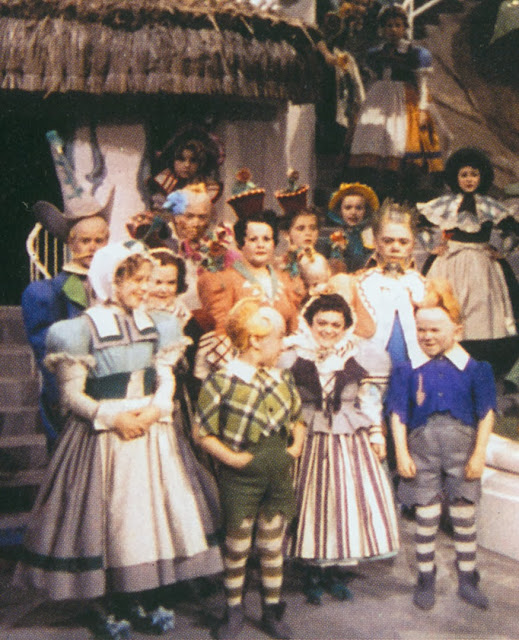
Carolyn Granger stands on the left in the front row in what appears to be a color test of the Munchkins in costume on The Wizard of Oz Munchkinland set. Jerry Maren stands center, to the right of Carolyn. The original of this picture is in the Technicolor Collection of the Margaret Herrick Library of the Academy of Motion Picture Arts and Sciences.

Leo Singer wasn’t always on the legal up-and-up with the little people he contracted with for The Wizard of Oz. In mid-November of 1938 MGM asked for a revised contract with many of the little people. Carolyn’s signature is the first one on the revised contract.

The revised contract between many of the Munchkin actors and MGM (Loew's Inc.). Carolyn's signature appears first. Ruth Robinson Duccini's signature is the second one on the right. Most, if not all, of the signatures on this first page of the revised contract appear to be from members of the Harvey Williams troupe.

I don’t know how long Carolyn Granger stayed with the Harvey Williams midget troupe after her work on The Wizard of Oz was finished in late 1938. She and Ruth Robinson Duccini both continued performing with the troupe for a time, since a newspaper article in the Mason City, Iowa, Globe Gazette mentions them both singing, tap-dancing, and cavorting across the stage in May 1941. One particular performance in the Ozarks stands out for Ruth. The people in the audience were so surprised to see little people that they stared at the performers as if they’d appeared “from under a rock.” During the early days of World War II the troupe performed in army camps in the south. Ruth left the troupe when she got a job with Douglas Aircraft during the war and then married in 1943.

Carolyn Granger is listed in the 1940 US Federal Census with her family at 106 Huntington Street in Chardon, Ohio. The Granger family appears in the census immediately after the family of Roy Robert Grant (1897-1988), my second cousin twice removed. (You can see a young Roy in the Grant photo I discussed in the blog post here.) The Grants lived about a block away from the Grangers on Town Line Road, which I believe is now Grant Street. Surely the Grants would have been aware of their neighbors the Grangers, and especially of Carolyn, then in her mid-twenties. As a little person she would have been noticeable.

The 1940 US Federal Census for Chardon, Geauga County, Ohio, lists the Granger family immediately following the Grant family. Remember, you can click on any picture on the Several Times Removed blog to see it larger.

I wanted to notice Carolyn in The Wizard of Oz after I learned of my family connection to her. I’ve seen the movie many times and can recognize Munchkin actors that I’ve met. But which of those many Munchkins dancing and singing to Dorothy on the Yellow Brick Road was Carolyn Granger? I located a couple photos of Carolyn in books about The Wizard of Oz movie and tried to impress her features into my brain. Last September the movie was re-released to theaters in a newly developed 3-D version for IMAX. David and I drove up to Hollywood to see it at Grauman’s Theater, where it premiered back in 1939. The movie looked beautiful. The new 3-D was tastefully done. But I didn’t spot Carolyn.

David and I saw the movie again a week or so later in San Diego at the Mission Valley Center AMC theater. It was sloppily framed and didn’t look as bright and shiny as the Hollywood screening. But it was still The Wizard of Oz. As usual, just after the Lollipop Guild finished welcoming Dorothy to Munchkinland, the Munchkins surged forward, singing “tra la la la la.” Suddenly there was Carolyn, just to the left of Judy Garland, jumping up and down with a big smile on her face. I’d recognized her.

Carolyn E. Granger plays a Munchkin in the 1939 MGM motion picture version of The Wizard of Oz. There she is just right of center, standing in the front row of the Munchkin crowd. The red arrow points to her. In the picture at the top of this blog post Carolyn Granger is peeking directly over the shoulder of one of the Lollipop Guild members, played by Harry Doll. Her face is just to the right of his.

At home afterward David and I watched the Munchkinland sequence again on dvd in order to make sure I’d been correct and so that we could pick out Carolyn in the rest of the scene. She stands in the front line of the crowd of Munchkins all during the Lullaby League and the Lollipop Guild songs, although she’s often obscured as the singers move back and forth. She’s fleetingly visible a few more times. But the moments where I’d first recognized her just before the Wicked Witch of the West arrives are the moments she’s most visible. Despite her death forty years ago, our distant cousin-by-marriage still looks so happy in those moments. She’ll look that happy as long as the 1939 motion picture version of The Wizard of Oz lasts. That ought to be a very long time.

If you’re an Oz fan, the journey over the rainbow never has to end. Oz has so many aspects, so many branches, there’s always something more, something new, something fascinating to discover and learn about. For me Carolyn Granger has been yet another fascinating aspect of the Oz phenomenon, but one that’s very personal because of my family connections to her.

Many of the Munchkin actors autographed this copy of The Wonderful Wizard of Oz by L. Frank Baum. Carolyn's signature appears about halfway down the right hand column. Margaret Williams Pellegrini signed two names below Carolyn.

Sunday, November 3, 2013

My Gay Relatives: Sally Balcomb and Betty Rodgers

Decaying sign for Bal-rone's Ashland Airport, 1967.
Time for some females in this series of posts on My Gay Relatives. In previous entries here and here I mentioned how the past doesn’t always reveal its secrets and that determining whether a past relative is gay is often difficult in a culture that historically tends to erase the fact of people being gay. But sometimes secrets are hidden in plain sight. Sometimes the people surrounding those secrets just don’t want to see them.

That seems to have been the case with my first cousin twice removed Sally Balcomb (1927-2007) and her longtime companion Betty Jean Rodgers (b. 1929). Sally was my paternal grandmother’s first cousin. My father recalls his family speaking casually and matter-of-factly about Sally and Betty—their two names together formed a unit. But it wasn’t until I was an adult that Dad finally put two and two together and realized that Sally and Betty were lesbians.

I can’t imagine that my father’s parents, Stanley Raymond Shanower (1917-1987) and Verna Lucille Evans Shanower, Sally’s cousin, didn’t recognize the situation. I believe they just chose not to think about it. My grandfather Stanley Shanower discussed homosexuality with me when I was twelve years old. I don’t remember how the subject came up, but I remember what he said about it. His understanding was that sometimes mothers dressed their sons in female clothing when the sons were young and those sons grew up to be homosexual. Even at twelve I thought this sounded a bit ridiculous, but I wasn’t about to argue with Grandpa on what I found to be an uncomfortable subject. Notice that he didn’t even begin to address female homosexuality. I bet it didn’t cross his mind at the time.

My grandmother Lucille knows that I’m gay. She’s met my partner David plenty of times and always mentions him in letters and when I speak to her on the phone. But I’ve never brought up the subject of my being gay with her in conversation. What I think is this—that Grandma can handle it if she’s not confronted with it.

And that’s what I think the family attitude was toward Sally and Betty.

Sally Balcomb was born in Elyria, Lorain County, Ohio, the daughter of my great-great-aunt Inez Irene Grandy Balcomb Kolinski (1892-1996) and Nelson Henry Balcomb (1888-1932). When Sally was five years old her father died. One afternoon Nelson Balcomb left in his car for a hunting trip. That evening his car was found burning, his body charred, the two shells in his shotgun discharged. His death was labeled a homicide. I have no idea whether Nelson Balcomb’s killer was ever caught, but it’s likely Nelson was a victim of the gang violence of Prohibition because of his job as a court stenographer. He’d been the stenographer during a highly-publicized libel suit two and a half years previous, in which William Peer sued Lorain Journal publisher David Gibson for labeling Peer a bootlegger. It was the longest trial of any kind in the history of Lorain County, Ohio, to that point. That case, or cases like it, brought Nelson Balcomb into contact with men who killed in ways similar to Nelson’s death. The police at the time acknowledged the similarity.

In any case, the 1932 death of Nelson Balcomb left five-year-old Sally fatherless. Sally and her mother Inez spent a lot of time visiting their friends, Mr. and Mrs. H. H. Gregg. Inez married again, in 1939, to Gust Kolinski (1879-1952), insurance salesman and real estate agent. Gust died of a heart attack in 1952.

Sally’s greatest enthusiasm seems to have been for aircraft. They became a major focus of her life. She learned to fly at the Ortner Airport in Birmingham, Ohio, and in Kansas City.

In 1954 Sally formed a partnership with Daniel Terlaak to purchase airplanes. They bought and sold airplanes and airplane parts. Eventually the partnership developed legal troubles. Workers sued them and Sally sued Daniel. After several years, the partnership dissolved. Sally went on to bigger things.

Bal-rone incorporates, 1959. Sally's signature is barely legible.
On February 13, 1959, Sally formed another partnership with Gary Mucciarone and Norman Cougill, both of Cleveland, Ohio. They called the company Bal-rone, Inc., a name formed from the first syllable of Balcomb and the final syllable of Mucciarone. Sally, as company agent, planned to lease the private Ashland Airport, in Ashland, Ashland County, Ohio, just off US Highway 250. Lawyer Kenneth R. Kolinski (1902-1975), Sally’s stepbrother from her stepfather’s first marriage, represented Bal-rone’s interests. In 1961 Sally purchased the thirty-year-old Ashland Airport, which had seen a lot of aviation history.

At first things went well for Bal-rone Inc. and its small airport. Sally continued to buy and sell aircraft and aircraft parts. She formed a local chapter of the Experimental Aviation Association and in 1963 the association gave her an award.

On September 2, 1965, tragedy occurred. A pilot crashed a Bal-rone airplane in Perrysville, Ohio, and died. A confidential report noted severe mental depression of the pilot and other indications of suicide.

This accident may or may not have been a contributing factor to Sally’s next step, distancing herself from Ashland Airport. More likely she was influenced by the growing desire of Ashland County to build its own county airport. On April 1, 1966, Sally leased Ashland Airport to the American Tower Company, Inc., of Shelby, Ohio. But when the one-year lease was up on March 31, 1967, American Tower declined to renew it, citing lost revenue. Ashland County, meanwhile, proceeded with its plans for a county airport. There were delays to those plans—including a lawsuit to stop the county from going ahead. There was also talk of turning Ashland Airport into the new county airport. But eventually the Ashland County Airport was built elsewhere.

Ashland Airport's final days, 1967.
At the end of 1971, Bal-rone Inc. filed dissolution papers with the state of Ohio.

I don’t know where or when Sally met Betty. Unlike airports, gay couples didn’t start to make the news until comparatively recently. But Sally and Betty were together for decades.

I met Sally Balcomb and Betty Rodgers only once that I know of—at the Methodist Church memorial service for my grandfather Stanley Shanower in Mentor, Lake County, Ohio, in May 1987. After the service there was a reception in the church hall. Two older women approached me and introduced themselves—Sally Balcomb and Betty Rogers. I’d never met them before, but as soon as they spoke to me I vaguely suspected that they were the two relatives that Dad had realized were lesbians.

I’m sure Sally and Betty suspected strongly that I was gay, but they didn’t talk to me openly about it. They were cleverer than that. They communicated indirectly. They knew I was a cartoonist, so they brought up Howard Cruse, the most famous gay cartoonist in the USA. I hadn’t met Howard then, but I was well aware of his career and said so. I was also very uncomfortable. It would still be a little over six months before I finally faced head-on the fact that I was gay. So I didn’t really talk with Sally and Betty about anything of substance. Now I wish I had. I may be projecting in retrospect, but the sense I got from them was that they were secure and content with who they were.

I mentioned Sally and Betty to my grandmother when I saw her last year. As far as Grandma knew they were still alive. I’ve subsequently found that Sally died in 2007. In Sally’s obituary, Betty is called Sally’s sister. Sister?—whether that’s coy, obfuscating, or just ignorant of the facts, it indicates Betty was still alive. Yet I can’t find her. The telephone number Grandma gave me is no longer in service. I assume I won’t be speaking with Betty ever again.

But at least I talked with Sally and Betty about Howard Cruse.

Cartoonist Howard Cruse and some of his creations.

Saturday, October 26, 2013

Supporting Steph

Not a great photo, but it's me and Steph Yakley.
Some current news. My fourth cousin Stephanie Yakley is currently battling ovarian cancer. She was in the hospital and undergoing chemo, but has now returned home. Here's a Facebook page if you'd like to send her some good wishes.

Steph and I share great-great-great-grandparents John Abraham Shanower (1814-1859) and Mary "Polly" Roush Shanower (1820-1896).

A benevolent fund has been set up at First Merit Bank for Steph. Due to chemo and the effects of the cancer, she has been unable to work since July. If you'd like to make a donation, no matter how small, you may do it at any First Merit Bank location, or you can mail a check to: First Merit Bank, 201 West 3rd St., Dover, OH 44622.  Write "Stephanie Yakley Benevolent Fund" on the memo line.

Any support, moral or monetary, will be appreciated.

Monday, October 21, 2013

Helen M. Russell Hietanen, 1928-2013

Helen M. Russell Hietanen, 1928-2013
Another relative that I never met has died. Helen M. Russell Hietanen, born January 27, 1928, passed away on October 10, 2013. The funeral took place last Wednesday, October 16. She was buried in the Millersville Mennonite Cemetery in Millersville, Lancaster County, Pennsylvania, where her husband Paul R. “Bobo” Hietanen (1935-1996) was buried in 1996.

My second cousin once removed Bob Hietanen, who’s also interested in family genealogy, knew his Aunt Helen and Uncle Bobo pretty well and has amusing stories involving them. I asked him why they were buried in a Mennonite cemetery. Was either of them Mennonite? I was interested mainly because so much of my father's Palatinate German Shanower line and collateral strands from the 1700s and on were Mennonite or a related Anabaptist sect. I thought it would be interesting if someone from my mother's Hietanen side was also Mennonite. But Bob says no, neither Helen nor Bobo was Mennonite and he doesn’t know the reason for a Mennonite cemetery.

Helen seems to have led a pretty active life up until the end. I offer my condolences to the rest of her family and friends. You can read her complete obituary here.

Sunday, September 22, 2013

Suomi Zion Lutheran Church

Suomi Zion Lutheran Church, circa 1920s.
My family has been associated with Suomi Zion Lutheran Church in Fairport Harbor, Lake County, Ohio, since its beginning. Members of my family were among the church's founders. The first meeting of the congregation took place on December 13, 1891, in a hall above a grocery store next to Wolff’s saloon on Water Street, before there was a church building. Officers elected at that first meeting included my great-great-grandfather Matti Uhmusberg Hietanen Sr. (1857-1915) as treasurer.

The first couple married in the Suomi Zion congregation were my great-great-great-uncle John Heikki "Henry" Hirvi (1860-1935) and Justiina Johantytar Somppi Hirvi (1875-1935). The marriage was performed by the congregation's first pastor, Reverend Abel Kiviola, on January 26, 1892. Henry Hirvi was also a signer of the church charter and from 1898 to 1903 held the office of vice president of the congregation.

The family of my great-great-great-uncle Henry Hirvi (Hervey). Back row, left to right: Weino Hjalmer "Wayne" Hervey (1901-1991), Olga Sigred Hervey Palmer (1894-1955), Saima Ilona Hervey Oliver (1892-1951), Thomas John "Tom" Hervey (1898-1958). Middle row, left to right: Elvira Justiina "Ella" Hervey Meyer (1896-1991), John Heikki "Henry" Hirvi (Hervey) (1860-1935), Justiina Johantytar Somppi Hervey (1865-1935), Richard Henry Hervey (1917-1962). Front row, left to right: Linda Emelia Hervey York (1905-1992), Hilda Marie Hervey Finneman (1903-1928). Photo circa 1922.

Construction of a simple church building on Seventh Street was finished in July 1892. The building was dislocated and damaged by a storm in 1893, but put back in place and repaired.

On July 12, 1896, a lot at the corner of Fifth and Eagle Streets was purchased. The church building was moved and substantially renovated. A foundation, a steeple, and a belfry were among the additions. My great-great-great-uncle Henry Hirvi and Oscar Hill Sr. built a new altar. My great-great-grandfather Matt Hietanen Sr. built the pulpit.

Suomi Zion Lutheran Church sanctuary, early twentieth century. The pulpit on the left was built by my great-great-grandfather Matti Hietanen Sr. My great-great-great-uncle Henry Hirvi helped build the altar.

An eight hundred pound bell was installed in 1898. The purchasing committee for the bell included my ubiquitous great-great-great-uncle Henry Hirvi. The bell still tolls today. The number of times it strikes indicates things such as the beginning of the Finnish service, the beginning of the English service, the death of a congregation member, and a funeral.

In 1901 the parsonage was built on the lot next door. The chairman of the parsonage committee was—take a guess—my great-great-great-uncle Henry Hirvi. The congregation agreed that members would take turns filling his position on the Pennsylvania and Lake Erie Company docks if Hirvi had to attend to parsonage affairs during the workday. The old parsonage remained beside the church until 1941 when it was moved to 428 Sixth Street and a new parsonage was built.  Also in 1901 the church balcony was enlarged to accommodate a manually-pumped pipe organ. About 1950 the most recent organ was installed, an M.P. Möller, Opus 8550.

The church established a Summer School in 1902 to instill patriotic and religious feeling into the youth of Fairport’s Finnish community. Confirmation classes were held beginning in the early years of the church. Members of my family appear in early photographs of both the Summer School and Confirmation classes.

Suomi Zion Lutheran Church Summer School, 1911. The first girl on the left in front is my great-great-aunt Elizabeth Stuuri Lehto (1903-1982). Sitting just to the right of her is another great-great-aunt, Elsie Emilia Hietanen Austin Behm (1904-1990). The boy third from the left in the top row is John Everett Ojanpa (1903-1968), my first cousin twice removed.


Suomi Zion Lutheran Church Confirmation class, 1902. The girl second from the right in the middle row is my great-great-aunt Liisa Emilia "Emma" Salo Klein (1887-1973). The girl second from the left in the back row is Maria Lepisto Hirvi (1887-1973), who married my great-great-uncle John Wilhelm Hirvi (1888-1918).
Suomi Zion Lutheran Church Confirmation Class, 1906. The girl on the left end of the middle row is my great-great-aunt Helmi Sofia Salo Syrjälä Haapala Lahti (1890-1961). The girl second from the left in the front row is my great-grandmother Wilhelmina Elizabeth "Minnie" Hirvi Stuuri (1890-1946).

In 1920 the original church building was moved to what eventually became the church parking lot and a new brick church was built on the old site. The new building was completed in 1925 and still stands at the corner of Fifth and Eagle Streets in Fairport Harbor today. The old building was converted into a gymnasium for a while. Then the building materials were reused to build what is now the Potti Funeral Home at 538 Fifth Street. This was the funeral parlor for my grandmother, "Muumma," in 1971, and all I could think of when I saw the name Potti—it was stenciled on the backs of all the chairs—was "potty." My mother was not amused.

Organizations within the church through the years have included choirs and singing groups, orchestras, Ladies Aid societies, the Luther League, the church council, and various committees as needs arise.

The church has continued to be a center of community in Fairport Harbor, especially for the descendants of Finnish immigrants to the USA. Church services in Finnish, in addition to weekly English services, are still held on the first Sunday of every month, as you can see on the church's website here.

Suomi Zion Lutheran Church—or simply Zion Lutheran, as it’s been called for decades—has been a touchstone in my life, too. It was where my parents were married in August 1962, although I was not around for that event. I was around in the summer of 1970 when I attended Vacation Bible School for a week. My great-aunt Adela Mirjam Stuuri Bixler (1918-2003) was teaching it.

Many of my relatives are buried in the church cemetery on East Street between Fifth and Independence Streets. Land for the cemetery was purchased in 1902 and clearing began in 1903. Among my family buried there are my grandmother Arlene Wilhelmina Stuuri Hietanen (1917-1971) and my grandfather Everett John Hietanen (1915-1998). I attended both their services at the church and their burials in the cemetery. The memorial service of my grandfather, “Paappa,” was the most recent time I was inside the sanctuary.

Suomi Zion Lutheran Church sanctuary today, from the church's website.

The most memorable feature of the sanctuary is the painting above the altar. It has nothing to do with my family directly, but all of my family who have attended that church can’t fail to have been struck by it. Painted by Reverend Hannes Leiviskä, pastor at Suomi Zion in 1905, it pictures Christ in Gethsemane. It’s based on the oft-copied Heinrich Hoffman original from 1890, now in Riverside Church in New York City. But Leiviskä used the Hoffman original merely as a starting point, adding substantial touches of his own. The most curious touch is what has always looked to me like a bolt of lightning in the sky. I remember attending Suomi Zion Lutheran as a child and trying to figure out exactly what was supposed to be represented by the brush strokes and paint colors forming this bolt. When I’ve seen the painting as an adult, it immediately evokes overwhelming nostalgia. Now it looks to me that what I thought was a lightning bolt is actually light reflecting from a cliff.

"Christ in Gethsemane" by Hoffman, 1890.
"Christ in Gethsemane" by Leiviskä, 1905.


I thank my second cousin once removed Sharon Ojanpa Mackey and Elaine Kangas of the Finnish Heritage Museum in Fairport Harbor, Ohio, for providing the Zion Lutheran Church 90th Anniversary booklet from which I took the black and white photos in this blog post.

Spirit of Finland Installed

In July I wrote about the sculpture Spirit of Finland, due to be installed in front of the Finnish Heritage Museum in Fairport Harbor, Lake County, Ohio. The sculpture, created by Ken Valimaki, represents Finnish immigrants to the USA. Last weekend the sculpture was dedicated during Fairport’s annual Community Days celebration. You can read about the ceremony here and see the whole process in a photo-essay here.

The sculpture committee includes a couple relatives of mine, my second cousin once removed Sharon Ojanpa Mackey and my second cousin once removed Ken Quiggle.

You can still donate to fund the lighting of the sculpture here.